Category Archives: Uncategorized

A Neat Hand

Oliver Senior, How to Draw Hands

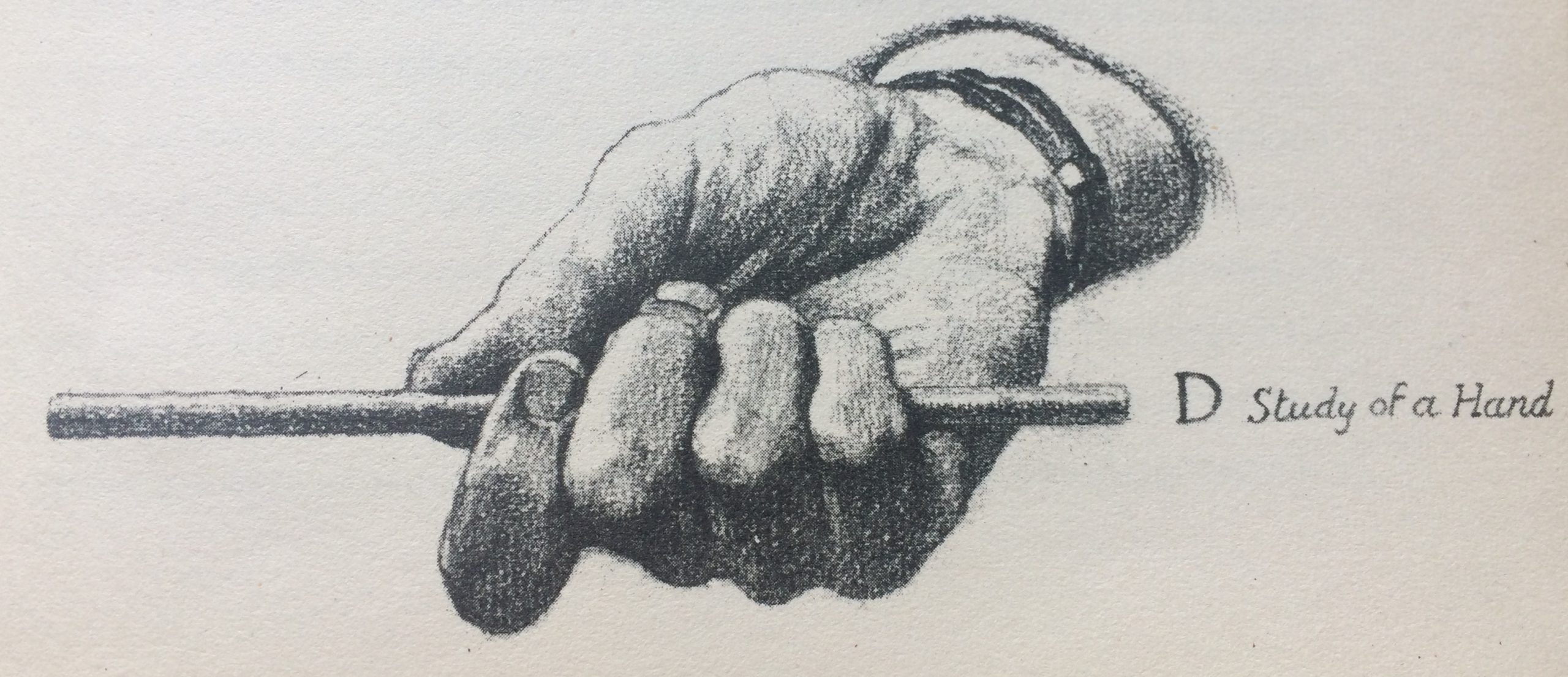
I’ve now written about the ideal paper, the ideal paragraph, the ideal sentence, the perfect inflammatory word, and the importance of spelling. It’s only fitting that I conclude this series with some reflections on font choice and handwriting. The latter is, of course, fast becoming a lost art or, at least, a niche craft, while the former is an object of both confusion and indifference. As we pass from the age of mechanical reproduction to the age of digital automation, I want to argue, we must retain our sense of the fundamental humanity of the written word, the phenomenology of literature, the aesthetics of writing, or what Roland Barthes called simply “the pleasure of the text”. We have to care what it it feels like to read our work.

In my writing workshops, I get participants to write a paragraph that they then have one of the other participants read out loud to them. Some of them work on paper, which provides a particular challenge. Some portion of the half hour that is devoted to actual writing in the workshop must produce a clearly legible draft. This normally means they have to devote two or three minutes at the end to actually rewriting the 100-200 words they have usually composed. Otherwise the difficulty that the reader faces will not indicate issues of composition but defects of calligraphy. If you do want to work mainly by hand, then you should certainly work on your handwriting. There may be all kinds of good reasons to do this.

Many people swear that they write (and even think) better with a pen in their hand than sitting in front of screen. Some people swear that they can only write well in front of a noisy typewriter punching the letters firmly onto a white sheet of paper. Much of this is no doubt a matter of habit. Already in high school, I was writing most of my papers on a word processor, so I’ve never felt any strong relationship between my handwriting and my stream of consciousness. I learned to touch type at the same age, so I really do feel that the words appearing on the screen are a natural extension of my mind. This is clearly a personal preference, however, and everyone should find a way to work that gives them pleasure. My point is just that, whatever means of writing you choose, resolve to do it well. Practice it. Become “good at” forming the letters and words in your chosen manner. You will enjoy it more.

But once you have written a text in a way that gives you pleasure you must also make a deliberate effort, a conscious set of decisions, to make your text pleasing to your reader’s eye. Many years ago, I found Josef Albers’ wonderful textbook Interaction of Color in a used bookstore and it has profoundly affected the way I teach writing, i.e., the interaction of words. At one point, he makes the connection explicitly: “The fashionable preference for sans-serif fonts in text shows neither historical nor practical competence,” he tells us, reminding us that sans-serif fonts (like Arial) are meant for captions not prose, while serif fonts (like Times New Roman), are based on the idea that “the more the letters are differentiated from each other, the easier the reading.” I always tell people to present their work for feedback in 12-point, Times New Roman, double-spaced, with no right justification (i.e., with a jagged right margin). It doesn’t look like a published page; it looks like a draft. It is optimal for reading and giving feedback.

Writing this post, I’m reminded of my poor habits. I have terrible handwriting, and I’ve been thinking about changing the font for the posts on this blog for years. Let me know what you think of this blog’s look in the comments, please. I’ve basically left it all up to WordPress until now, but I should take my own advice and take control of my aesthetics. Typo-graphy is an interest in the (blow by blow) impression of that the shapes of letters make on your reader; calli-graphy is a cultivation of the beauty of letters on the page. These issues are neither trivial or vain. Take some pleasure in dealing with them effectively.

Correct Spelling

Two quick very true, very embarrassing stories. As an undergraduate, I once found myself in the campus pub being gently corrected in the middle of a profound philosophical argument by a sorority girl, who explained to me that the word I was trying to use to devastating effect was, in fact, “construe”, not, as I seemed to think, “conscrue”. That same year, no doubt, I tried to shock a professor by comparing consciousness to an ordinary bodily process like, “e.g., a bowl movement”. He did not fail to point out in the margin that my attempt to be witty had been undermined by my inability to spell. Some words we learn the hard way.

Orthography is the study of the right (ortho-) way of writing (-graphy) words. In my two examples, I understood the word I was using correctly, but I did not know how to spell it. It is possible that, though I had said it often, I had never in my life written the word “bowel” before using it in that paper. And I may never have “construed” anything explicitly before I heard — and did not read — my professor doing so. My error stemmed from what Steven Pinker has called the Igon Value Problem: “when a writer’s education on a topic consists in interviewing an expert.” In fact, this reminds me of a third embarrassing tale: the time I wrote about “Göbbel’s” (!) incompleteness theorem on the basis of lecture by W.V.O. Quine that I had attended. I really did mainly squander my learning opportunities as an undergraduate. Words aren’t just sounds we make to sound smart, they are signs we read to actually become smart. Learn how to spell them.

I know this is tough love. I hope it’s clear that I have a great deal of empathy for undergraduates and their struggle to learn the curriculum. My point is that there are lots of lessons hidden in seemingly trivial details. Sometimes spelling is a clue to a word’s etymology, sometimes a way to avoid confusing it with another. Do you mean “free reign” or “free rein”? Are you “the sun and the air” or “the son and the heir”?

And then there’s the spelling of names. I mentioned Thomas Kuhn’s The Structure of Scientific Revolutions the other day and the auto-generated closed captioning on the YouTube video apparently heard me say “Thomas Coons”. If I had been teaching the philosophy of George Berkeley, it would no doubt have captioned it “George Barclay”. If your discipline is organized around the works of Barbara Czarniawska (who my browser can’t even spell) or Mihaly Csikszentmihalyi (who it actually can!) you’re going to have to take spelling seriously. Even relatively simple names like Bourdieu or Ricœur are worth learning well if you’re going to be using them often.

Students sometimes ask whether “spelling counts” and, of course, it matters less and less as spellchecking becomes better and better. But poor spelling can reveal that you’re not very familiar with the material you’re so confidently holding forth about. By the same token, taking the time to look closely at how big words are put together at the level of the letter is actually a good, if very simple, way to build some intellectual confidence.

The Right Word

If I put ‘blue’ after ‘stones,’ that’s because blue is
the right word, believe me.

Gustave flaubert

Leonard Cohen once asked us to imagine the reunion of two old lovers in a hotel room, somewhat embarrassed by the “outrageous hope and habits in the craft” as they search for the “special caress, the perfect inflammatory word” that might prove that they’ve “survived as lovers ([if] not each other’s)” and now “own [their] own skins”. Scholarship is perhaps not so romantic, but it is important to remind ourselves of the aesthetic pleasure that follows from finding just the right word, le mot juste, to describe what we have learned from our studies, and imagine, as Nabokov imagined, the hairs on the back of the reader’s neck standing up. If only for a moment, we feel that we have found a way to preserve our knowledge forever. “What thou lovest well remains,” said Ezra Pound, from whom Cohen got his title: “the rest is dross.”

Of course, just as there is no ideal paper, no ideal paragraph, and no ideal sentence, there is no such thing as the perfect word. Words are simply imperfect when compared to the things they name, which, though perhaps themselves inevitably flawed, are nonetheless exactly themselves, exactly what they are. We might of course also say that words are always true to themselves; but what will always be imperfect is the relationship between words and things. (“What relation must one fact have to another,” asked Bertrand Russell, “in order to be capable of being a symbol for that other?”) Finding the right word is part of the struggle with what Robert Graves called “the huge impossibility of language,” the effort “to depict not the thing but the effect it produces,” as Mallarmé put it, or, again, the delicate search for Cohen’s “perfect inflammatory word”.

“The mission of the poet,” said Borges, “should be to restore to the word, at least in a partial way, its primitive and now secret force.” Heidegger would no doubt have agreed. “The ultimate business of philosophy,” he said, “is to preserve the force of the most elemental words in which Dasein expresses itself.” Both were concerned that what Borges called the “usury of time” was deflating the meaning of our words; indeed, Heidegger reminds us that we’re disposed to think of our guilt in terms of a “debt” we owe to “Them”. We must recover the force of language, one word, perhaps, at a time. We must know what they mean and insist on their meaning. That may be exactly what good writing is.

Again, I know you’re not as romantic about your words as the poets and philosophers of yore. But yesterday I attended a talk about foreign language studies at business schools that reminded me that we should encourage students to learn languages, not so much because it will give them access to foreign markets, but because it will give them access to exotic pleasures. You don’t need to spend a whole day, as Flaubert is reputed to have done, trying to decide whether a stone is “azure” or just “blue”, but there is a real satisfaction in finding a word that means what you want it to, both semantically and etymologically. Once you know what, say, “trenchant” and “salient” really mean, you can begin to deploy them in your writing to produce precise effects for the knowledgeable without too much confusion for the ignorant.

“I see that we no longer follow fashion,” says Cohen as he “makes a gift of necessity.” Many of our words enter the vernacular as fashions of the moment and leave it as they came. To insist on using a word, not because that is what “one” says (what “they” say) but because it is the word that means precisely what you want to say, is an essential part of the discipline of writing. Sometimes this forces you to write the sentence in a way that accommodates the word in question, sometimes it means finding another word that works correctly in the context you have already established. Make your gift of whatever is needed. Remember that “blue” is only the right word after “stones”. Believe me.

The Ideal Sentence

When I arbitrarily write a single sentence, for instance,
‘He looked out the window,’ it already has perfection.

Franz Kafka

Ordinary sentences express thoughts; ideal sentences present ideas. The writer has a thought “in mind” when writing a sentence, and the sentence evokes a thought in the mind of the reader, but these are two different thoughts in two different minds. If I write the perfectly real sentence, “I am looking out the window,” a particular image may come to mind for you, but it is not the image of what I am looking at as I now look out the window. The idea of looking out a window, by contrast, exists independently of your mind and mine, my thoughts and yours, our windows and what happens to be outside them at the moment. The ideal sentence is about a stable reality, not the passing scene.

A real sentence gropes at this reality with words, which are but inarticulate grunts when compared to the songs of angels that minister to our ideas. A real sentence, even one that invokes “the song of angels,” as I just vainly tried to, represents only what happens to be passing through the medium of the writer’s muddled mind. The ideal sentence, by contrast, presents an idea, immediately, in its pure form, as it appears in the mind of God. Ideas exist “in themselves,” regardless of whether they have been thought by anybody. Ideally, the writer is as distant from the idea as reader because the ideal sentence puts them both in the same position. In a sense, at an infinite distance.

Ideal sentences, of course, don’t exist in reality. We have no words for them. But every real sentence aspires to one; a reader is always trying to discern the ideal sentence in the real one that is passing before their eyes. They are trying to understand what the author means, indeed, what the author must have meant, not necessarily what the author was thinking when it was being written.

One good reason not to try to read the writer’s mind “in the moment of writing” is of course that the sentence you are reading is often the result, not just of writing, but of a great deal of editing. By the time the writer is finished with it, the thought that originally inspired it is long gone. But the idea remains, and it is in fact all that remains after all the writing and reading, all the intending and understanding, has been carried out. Just as spoken words dissolve in the air as quickly as they are uttered, so a written sentence vanishes in the mind of the reader, leaving first images and then, finally, “the loneliness that is the truth of things,” as Virginia Woolf put it, which is all the writer shares with the reader at the end of the day: a set of coordinates on the plane of ideas.

In order to make sense of your words, the reader is going to have to think. That is, the sentence cannot present your idea without allowing the reader to consider what you mean. In fact, the sentence will have to make the reader think. But it’s not finally the thinking that you are trying to bring about. You want the reader to get the idea.

The Ideal Paragraph

The ideal paragraph takes one minute to read. It occupies exactly one minute of the ideal reader’s attention. In an academic setting, the reader is, ideally, another knowledgeable person, an intellectual equal, a scholarly peer. If the writer had not written it, but came to it with fresh eyes, it would take the writer a minute to read it too. During its allotted minute, the paragraph supports, elaborates, or defends a single claim, and both its position (the claim) and its posture (support, elaborate, defend) should be clear to the reader before the minute is over. The reader is now able to distinguish the key sentence from the rest of the paragraph. The reader feels that the paragraph has helped them to believe, understand, or agree with the proposition that the key sentence expresses. The paragraph has overcome the difficulty it presented to the reader. Ideally, the reader then moves on to the next paragraph.

The ideal paper is a series of one-minute reading experiences. Ideally, however, the reader does not experience the reading at all; the reader experiences the ideas that the writer has on their mind. The prose, as George Orwell put it, is “like a window pane”. Ideally, the ideas pass before this window on the mind of the writer in an orderly manner, one at a time, coming into view and moving along in moments that last a minute each. During that minute the reader is given enough information to answer the two questions that Wayne Booth could not believe the tutors at Oxford confined themselves to asking of any text: “What does the author mean?” “How does the author know?” (“No university could be that good,” he said.) The ideal writer of the ideal paragraph is writing to be read in this ideal tutorial. I might add that classes at the Copenhagen Business School are scheduled to last 45 minutes. The ideal paper has forty paragraphs.

I said that the ideal paragraph takes exactly one minute to read. A paragraph does not become better by getting the job done faster but by getting more work done in the minute it has to do it. If the paragraph is able to support its key sentence in thirty seconds of a qualified reader’s attention, it is not hard enough to believe; if it can be elaborated in 45 seconds, it is too easy to understand; and if it takes two minutes to defend, it is simply too disagreeable. The solution is to adjust the difficulty of the key sentence so that exactly one minute of support, elaboration, or defense is what is needed. An ideal paragraph resolves an ideal difficulty under ideal conditions for an ideal reader. Under these conditions — under exactly these conditions — the reader is qualified to the tell the writer that they’re wrong.

In an ideal paper, made of ideal paragraphs, the key sentences are at most two minutes apart. There is no ideal position for the key sentence; it can be the first, second, penultimate, or last sentence, or it can be anywhere in between. If the key sentence comes first in one ideal paragraph and last in the next there will two minutes between them in the mind of the reader. Elsewhere in the paper, the reader may be led from the key sentence at the end of a paragraph directly to another key sentence at the beginning of the next. Sometimes, one idea is separated from another with a bright line, sometimes the nuances of one shade off into the nuances of the next. “Right orientation, disposition, atmosphere,” said Michael Andews, the painter; “it’s reassuring to know these things.” As musicians say, it’s all about finding the pocket.

No paragraph is ideal. The writer is constrained by the imperfections of being human, of being materially embodied and socially situated, of working under conditions that are, to put it mildly, less than ideal. So, some paragraphs will take more than a minute to read and some will pass much too quickly. Reality, let us say, intercedes in the process. This is for the most part to the good because we want our writing to be about something, we want it to refer to reality, to the very conditions that force us from the ideal path, that prevent the expression of our talent in the perfect immanence of the presentation, as Kierkegaard put it. To approximate this perfection, however, the writer arranges the work in moments that last 27 minutes each, and often spends more than one such moment reworking a given paragraph. Each time, the writer gives twenty-seven times more to the idea than the reader takes from it. What remains is real.