Category Archives: Uncategorized

A Place to Care About

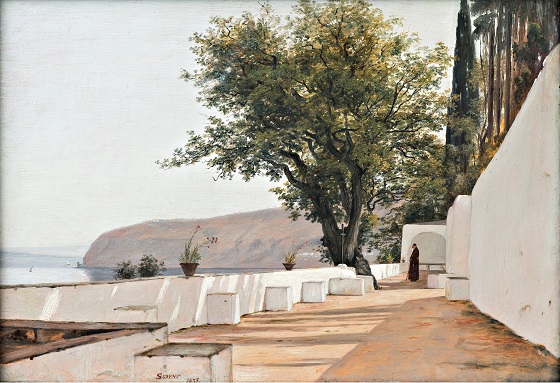
Martinus Rørbye, Scene Near Sorrento Overlooking the Sea, 1835.
(Source: Nivaagaard Collection)

I had an illuminating exchange on Twitter with Dana Ferris the other day. It was about my last post, which suggested a simple writing exercise: write a five-paragraph essay that explains how to find some interesting thing or place you know the location of. I had tweeted that I thought it might be a good way to start a college-level writing class, and challenged critics of the five-paragraph essay to, well, critique it. After all, if they are right then there’s something wrong with the exercise I suggested.

A discussion would be useful since the exercise is actually very similar in content to some of the tasks that John Warner suggests in his widely praised Why They Can’t Write: Killing the Five-Paragraph Essay and Other Necessities. Warner suggests students explain in writing how to make a peanut butter sandwich and then move on (as I also suggest for future assignments) to explain how to do something they are expert at. We agree about the value of giving students simple, well-defined tasks that they have the content knowledge they need to complete, allowing them to focus on the choices they have to make as writers. What we disagree about is whether to place formal constraints on the tasks as well. I think this is a very good idea, while Warner and others think it’s a very bad idea. Indeed, they think it is harmful to the students’ ability to write and even, at times, to their health. I was curious to hear how my exercise might be harmful or, at least, useless.

“I don’t need five paragraphs to address that topic,” Ferris tweeted in response. “I can do it in two words: ‘Ask Siri.'” Now, it’s important to keep in mind that Dana Ferris is a professor of writing and linguistics at UC Davis, and the director of the Writing Center there. She’s also a contributor to Nigel Caplan and Ann John’s new edited volume devoted to “moving beyond the five-paragraph essay.” (Caplan had cited her chapter in his own response to my tweet and tagged her in.) That is, Ferris is an accomplished scholar in my discipline, a leading theorist of my practice. As in law, medicine and engineering, our credibility depends in part on communication between professionals and professors, and in this case the communication was rather terse; my exercise was summarily dismissed. I suppose my professional vanity was stung a little.

“I know she’s joking,” I said, retweeting Ferris, “but one of the saddest things I know is a professor of writing suggesting that writing has been made obsolete by technology, that there is ‘no need’ for it. Perhaps not, but there’s the simple pleasure of it. A good instruction book is like a poem sometimes.” (Regular readers of this blog know how fond I am of instruction books, from How to Draw Hands to Rational Grazing.) She was kind enough to respond:

I was being flip, but my point was that your assignment that you “challenged” people … to critique is that it lacks purpose–or, as you implied, its purpose is to teach a form that students could use later. As a teacher of writing, and teacher of writing teachers, I have always believed that purpose and content determine form. Your assignment forces students into a topic they may not care about in a form that will not serve them. So that’s my critique, since you asked for one.

I did indeed ask for a critique, and this was more along the lines I had hoped. After all, “Ask Siri” would be an appropriate (if, yes, flip) response to almost any knowledge-based assignment, including Warner’s peanut butter sandwich exercise. By specifying a five-paragraph essay, I am requiring the students to actually do some prose writing. (In the first iteration, Warner’s students apparently often give him a numbered list of steps.) But I found Ferris’s critique a bit off the mark, since I had deliberately tried to make the task more purposeful than Warner’s. A peanut butter sandwich is arbitrary, and I understand the value of insisting that they just play along with him for a moment (I do similar things in my teaching and coaching), but I had in fact asked them to pick a place they themselves thought would be of interest to their fellow students. I pointed this out in my response:

You didn’t read the assignment carefully enough. The students are to choose a place they care about and want to share with others. They’ve misunderstood the assignment if they don’t see a purpose. And the form simply specifies the patience of the reader (5 minutes).

Ferris’s response to this surprised me.

But it’s YOUR purpose. What if students don’t have “a place they care about”? That’s a concept loaded w/privilege: What if you moved around a lot, didn’t take vacations? What do you write about for five paragraphs? You’re forcing them into the content AND the form.

If you look back at her earlier critique, you’ll see why I hadn’t expected this response. “Your assignment forces students into a topic they may not care about,” she had said. But when I now suggested that it explicitly lets them choose a place they care about, she objects to my requiring them to care about anyplace at all — indeed, anything, since I also let them write about some object they knew the location of.

But “care” was her requirement, not mine. Indeed, there is an important etymological connection, one that I hadn’t even noticed when I designed the assignment, between my “place they care about” and Ferris’s “topic they may not care about”: topos is Greek for place. I’ll return to that at the end, but do note that I didn’t tell the students they had to care. I told Ferris that I had, in fact, given them an opportunity to care. I merely assumed that students could think of a place, or just a thing, that other people would be grateful for hearing about. Also, please note that I specifically ruled out places they care so much about they don’t want to share. (I don’t like forcing them into personal writing.) To use the concept of “privilege” to censure those sorts of very mild assumptions about our students borders, at least to me, on self-parody. We are no longer to expect students to care about anything? Caring is something only elites do? Like I say, the response surprised me.

Of course, I still imagine that Ferris hadn’t thought it all the way through, that she hadn’t really taken my exercise seriously, nor felt it worthy of a real, detailed critique. Like Caplan and Johns, and Warner, she thinks five-paragraph essays lack purpose by definition, and no amount task-specification can resolve this. They seem to think that once you’ve told college students (who are presumably fully indoctrinated by their high school experience) to write a “five paragraph essay” (and they’ll interpret “essay” simply to say that) they assume they can’t do anything meaningful. Students, so the theory goes, will now think that they can only try to please their teachers. And once you’ve given them formal constraints, they’ll imagine that conforming is the only standard against which they’ll be judged. The students would presumably be shocked to learn that their 750-word five-paragraph essay, complete with introduction, body and conclusion, wasn’t very good. Perhaps they’ll be puzzled even to learn that it could be improved? They would be outraged, I guess, to be told that it was boring. “Of course, it’s boring,” the student would balk. “I did exactly what you told me to do!” What saddens me is that academic writing instructors, indeed, professors of academic writing instruction, seem willing to validate this response. I don’t. I tell them to write a good five-paragraph essay. I tell them to face the difficulty of writing, and I help to do this effectively.

In my next post, I’ll continue this theme by going back to an insight I had many years ago, which will also address Ferris’s other point of critique, viz., that I am “forcing” a form on them. The academic essay, I want to argue, offers a way to engage meaningfully with our peers because it occasions what Heidegger, following Aristotle, called the topos eidon, “the place of forms”. It’s a place I care deeply about and I know, if I may be so bold, where it is. I try to show students how to get there. You could ask Siri, but I don’t think that’s going to help you find it.

Where to Find It (an exercise)

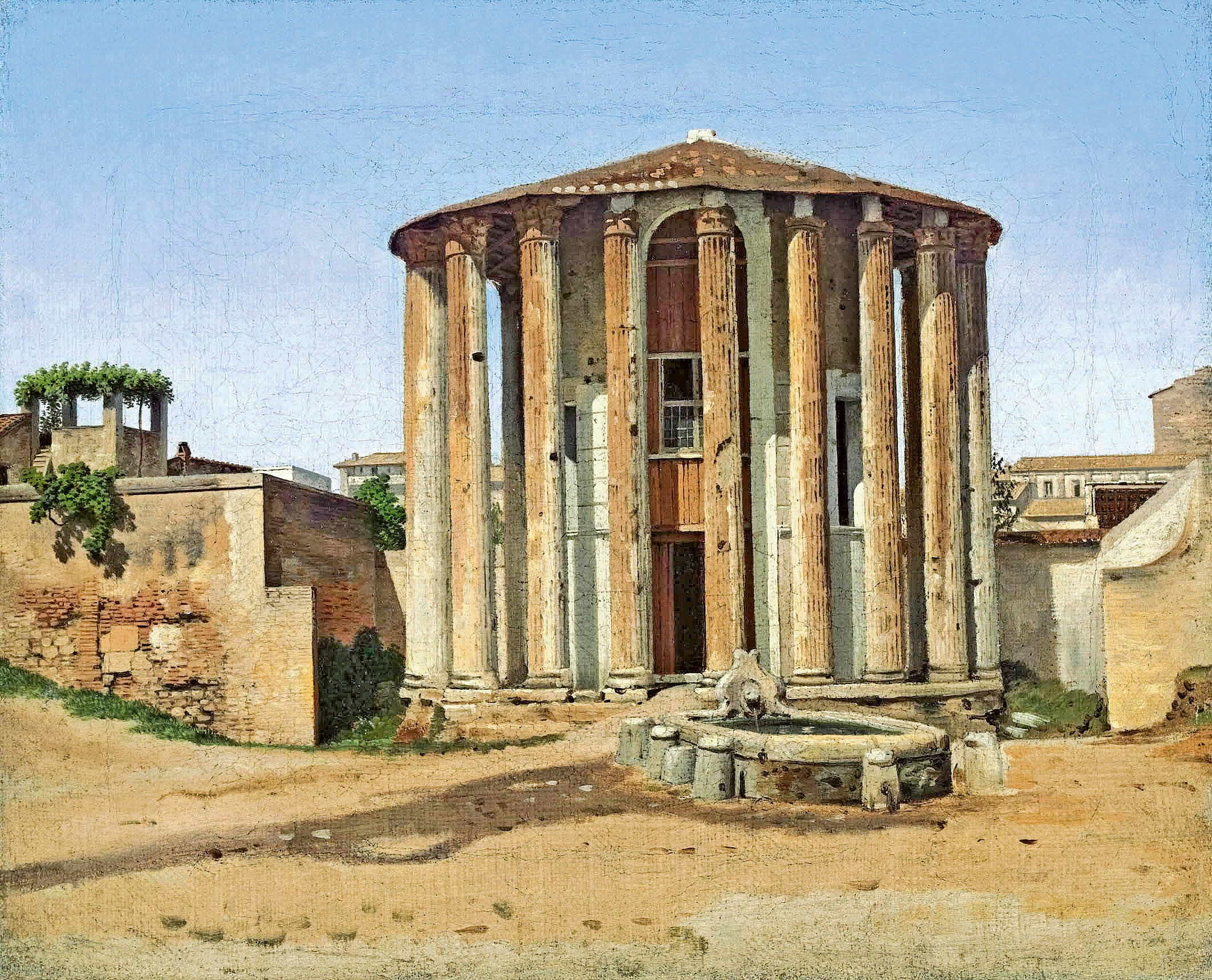
C. W. Eckersberg, Vesta Temple in Rome, 1814-1816, Source: Nivaagaard Collection

Think of a place you know well or a thing you know exactly where to find. Make it an interesting place or thing, and make it one you’d like others to be able to find. I’m not thinking of your special place, or secret stash; I’m thinking of a place or thing that other people will be grateful you told them about and helped them locate. There must be lots of them to choose from, and I want you to just pick one of them — one, like I say, that you know well. You not only know how to find it but why someone would want to. When imagining the “someone”, the “other people”, just think of your fellow students in a class, or your peers in your scholarly discipline.

Your assignment will be to write a five paragraph essay that explains where this thing or place is — how to find it. It will take roughly five minutes to read. I want you to think seriously about how to begin, which also means imagining that your reader begins somewhere, in some location (some distance from the destination) or in some state of deprivation (in need of the thing you know how to find). Choose a common location, one that will be familiar to most readers or, at least, one that they will be more easily able to find than the thing or place you’re going to be guiding them towards. I also want you to think seriously about where they’re going to end up. Just before they find it, what will they be experiencing? What puzzle may be confronting them? Should they turn right or left? When you say, “open the drawer,” will there be any doubt as to which drawer you’re talking about? What’s the last thing they will see before they see the thing you want them to find or arrive at their destination? And how, finally, will they know they succeeded?

In between, you have to write three paragraphs. That means at least 18 sentences and at most 600 words. Be strategic about this. Choose a problem that can be solved within that space. And make sure it can be divided meaningfully into three sets of instructions. Don’t make it so far away or so difficult to find that you’ll need thousands of words to make it clear. But also don’t make it so easy that the reader feels like you’re just wasting their time and that they would have been there by now if you had just gotten to the point. Pick a place or thing to find, and a place or state to begin with, that puts meaningful bounds on the problem. Understand the deep connection here between your problem as a writer and your reader’s problem as a seeker. You’re trying to help them find something.

Give yourself three hours to write the essay. That gives you time to spend 27 minutes on each paragraph, taking a three-minute break between them. You’ll also have a bit of time (say, 15 minutes) at the beginning to think about what you’re going to write about and at the end to read it through and fix minor things. Since you get to choose where to begin and what to find based on your own knowledge, and since your reader is just a fellow student in your class, the “knowledge” that is needed here is entirely yours to decide. You will presume your reader lacks some knowledge, but also that they have some other knowledge (or they wouldn’t know what you mean at all). Make these assumptions wisely. Finally, remember that you have more than 30 times longer to write this thing than the reader has to read it. Remember to enjoy this advantage.

Please keep this concrete. Don’t guide your reader towards some abstraction. Don’t tell them how to find love or their dream job. That’s another assignment for another day. Next time, perhaps, you can explain to the reader how to do something you know how to do well. Another time, you can write about how to observe a particular fact of nature, or how to comply with a particular cultural norm. You can explain how to build a physical structure or how to solve a social problem. The variations are infinite. But, for this one, just tell your reader how to find the Phillips screwdriver in your shed or the best bench in your favorite park.

Ian Bruce on the Accommodationist/Critical Binary

In Academic Writing and Genre (2008), Ian Bruce reflects on the debate between those who adopt an “accommodationist” pedagogy in their writing instruction and those who adopt a “critical” pedagogy. The goal of the first is to help students “master the conventions and values of academic writing”, while the second “encourages the questioning and challenging of such norms and values”. Actually, he draws the distinction a bit more categorically. Those in the first group, he tells us,

proceed on the basis of an accommodationist (sometimes referred to as assimilative or pragmatic) pedagogy, which assists students to master the conventions and values of academic writing in an uncritical way. (p. 10)

Thus, the opposition to the “critical” approach is essentially there by definition. I agree with him that such a “simple binary” is not the best way to frame a constructive debate. But I’m not sure that merely adopting both approaches is the best way forward either. I will quote his proposal at length and then offer my alternative.

The view taken in this book is that effective writing pedagogy that uses a genre-based approach (as a means for developing novice writers’ discourse competence) has to be both accommodationist and critical at the same time. Accommodationist here is taken to mean exercising a discourse competence by being able to understand and appropriately draw on the various types of systemic knowledge necessary for producing discoursal outputs. Critical here is taken to mean a novice writer being able to exercise an authorial voice by individuated and innovative use of the various aspects of discourse knowledge at his/her disposal. (p. 10)

The problem with this approach, to my mind, is that it requires us to adopt a dual perspective, letting both sides win, but leaving the barrier between them in place. We might say it fails to fully transcend the binary that Bruce is rightly dissatisfied with. The most effective way to deconstruct the binary, in my opinion, is to recognize that you can’t “accommodate” the norms and values of academic writing in an “uncritical” way. Indeed, criticism is one of the central values of academic writing. I go so far as to say that it’s the core “business” of scholarship. Likewise, you cannot exercise “discursive competence” in an academic context without also exercising an “authorial voice”; you can’t draw on disciplinary knowledge “appropriately” without making “individuated and innovative use” of it.

My feeling is that the “critical” pushback against “conventional” academic writing too often challenges a caricature of what it means to be “academic”: boring, formal, reserved, dispassionate. What we really need is a single, unified understanding of the use of academic language that maintains the essential tension between philosophical clarity and poetic intensity, which is the hallmark of good writing in any genre. Students and teachers can of course focus on one or the other, but they are not thereby choosing between accommodating and criticizing academic norms. They are accommodating the critical norms of academic work.

“A center around which, not a box within which”

One of the first things an apprentice woodworker learns is how to make a box. The ability to join five pieces of wood together along their edges to form a continuous surface that can hold a certain volume is useful in all sorts of other applications. For example, many tables are made by connecting the legs, not directly to the tabletop, but to a box apron underneath it, which both gives the legs greater stability and prevents the top from groaning under a load. A bookcase is an upright box, divided by shelves, and the base is usually just another box orthogonal to the first. You get the idea: a cabinetmaker who can’t build a box isn’t much of one. But being able to build a box isn’t the end of the story either. You have to know how to put boxes together and how to add all manner of practical and decorative features to them.

In a new volume edited by Nigel Caplan and Ann Johns, the five-paragraph essay is defined as “an approach to writing that is insensitive to context, rhetorical situation, audience, or communicative purpose” and which “presents a single, prescriptive, and specific form for all student writing.” John Warner frames his opposition to the form in similar terms, insisting that it’s not the form as such that there’s anything wrong with but its universal application to all writing tasks in the academic environment. This characterization of the five-paragraph essay has always puzzled me, I must say, since I can’t imagine why any teacher would think that a single, specific form could be used for all the writing that students do. Nor can I imagine how a student can come to think that the constraints of one particular assignment would apply to all other assignments. But Caplan, Johns and Warner are closer to the action (in the US) than I am (in Denmark) so I will take their word that this view is widely held. As such, I’m here to help them oppose it.

William Carlos Williams told us to think of a poem sometimes as a “machine made of words” and sometimes as a “field of action”. Putting it in these terms, when the master tells the apprentice to join five pieces of wood to make a box, a rich field of action opens up. A box is a machine made of wood, a thing for holding other things. There are many decisions to be made, some of which the master may make for the apprentice to focus attention on particular difficulties to be overcome, particular “learning outcomes”, to use today’s terminology.  The master may specify which pieces of wood to use, or how big the box must be. The apprentice may be asked to make one with a lid or to get the job done in under an hour. The master may likewise leave the choice of materials, the box’s dimensions, and the timeframe open, specifying only a function. “Build the ideal box to store dry rice in the kitchen,” for example. The apprentice will now have to learn something about rice and perhaps what happens in a kitchen. It is the master’s job to set up a situation, a purpose, an end-user — a field of action — within which the student can learn something.

Ezra Pound taught Rosmarie Waldrop to think of the prose poem (a lyrical paragraph) as “a center around which, not a box within which.” She called the relevant field of action “the lawn of excluded middle”, a place where contradictions can meet and work things out, like children playing in front of the house. An academic paragraph may not be as much fun, but the idea is the same. In a paragraph we play the truth and the meaning of words off each other in the reader’s imagination, hoping that by the end they get at least our meaning, and hopefully our truth. There is no one particular right way to do this, no universal prescription that can get the job done. “[T]he four points of the compass are equal on the lawn of excluded middle,” Waldrop says, “where full maturity of meaning takes time the way you eat a fish, morsel by morsel, off the bone.” This is where language happens.

To me, the five-paragraph essay is merely one place that writing can take place. It should never be presented to students as a universal norm for all writing, not even for all the writing they will do at school. But its unit of composition is, let’s say, widely applicable. It is rare that they will not be able to approach their task as the construction and arrangement of paragraphs, just as a piece of furniture can often be approached, at least as a first approximation, as an organization of boxes. By reducing the students’ range of rhetorical choices (by making a number of decisions for them) we can draw their attention to the potential of particular ways of putting words together, particular sentence structures, particular dispositions of the paragraph. One day, the student may find a way to accomplish a writing goal without writing a single coherent paragraph, just as the apprentice may build a bookcase without a single box. “Sometimes a bookcase is not a box within which, but a line along which,” they might say. But to have gained mastery of a basic form is not an obstacle to their work. It is the center of their strength.

Beneath the Five-Paragraph Essay

Nigel Caplan and Ann Johns have just published a book that proposes to “debunk” the five-paragraph essay. As usual, this sort of rhetoric gets my back up. I use both the letter and the spirit of the five-paragraph essay in my own coaching and teaching, not, of course, as the end-all and be-all of writing, but as a good clear place to begin, a simple machine, like a lever or an inclined plane in physics, a scale or chord progression in music, a model or color study in art class. Whenever someone sets out to debunk it — or, worse, to “kill” it — I feel a bit defensive, perhaps protective. I want to spend a post or two outlining my reaction.

John Warner emphasizes that the five-paragraph essay is not so much a “cause” as an “avatar” of bad writing. “By itself, the five-paragraph essay isn’t necessarily a problem,” he tells us; the issues arise in the way it is used in the classroom and, especially, in assessment. Caplan and Johns are also more concerned with the use of the form than the form itself:

We want to be clear from the outset that the number of paragraphs is unimportant: What defines the five-paragraph essay is not the magical trinity of body paragraphs but rather an approach to writing that is insensitive to context, rhetorical situation, audience, or communicative purpose. Instead, the “five-paragraph essay” presents a single, prescriptive, and specific form for all student writing. (P. v)

On this point, I can of course agree. I would never defend “an approach to writing that is insensitive to context, rhetorical situation, audience, or communicative purpose”. Indeed, I use the five-paragraph essay and variations on that form to get students and scholars to think about things like context, situation, audience and purpose, as well as their own epistemic basis for saying what they want to say. What then is pitting me against Warner, Caplan and Johns? What battle have I enlisted in? What history am I on the wrong side of? I want to get the bottom of this.

This blog is called Inframethodology, which is intended to evoke “the underlying craft of research”. Having been trained as a social epistemologist, I’ve long been interested in the social and material conditions of knowledge production. This means understanding the complex relationship between the product and the process of research. So I am very sensitive to the way a form, like the five-paragraph essay, can be institutionalized and placed in the service of darker forces than it was originally designed to serve. In fact, I am reminded of a very apposite observation that Ezra Pound made in his ABC of Reading:

It is hard to tell whether music has suffered more by being taught than has verse-writing from having no teachers. Music in the past century of shame and human degradation slumped in large quantities down into a soggy mass of tone.

In general we may say that the deliquescence of instruction in any art proceeds in this manner.

I. A master invents a gadget, or procedure to perform a particular function, or a limited set of functions.

Pupils adopt the gadget. Most of them use it less skilfully than the master. The next genius may improve it, or he may cast it aside for something more suited to his own aims.

II. Then comes the paste-headed pedagogue or theorist and proclaims the gadget a law, or rule.

III. Then a bureaucracy is endowed, and the pin-headed secretariat attacks every new genius and every form of inventiveness for not obeying the law, and for perceiving something the secretariat does not. (P. 200)

I think Warner, Caplan and Johns would grant that the essay (a composition of n paragraphs) is an apt gadget for a limited function. The invention of the paragraph and ways of arranging several paragraphs to indicate a larger argument is not, in itself, the problem here. Nor, I would imagine, is the introduction-body-conclusion form worthless in the presentation of one’s ideas. The problems arise in stage II and III, when the gadget is turned into a rule and the rule is enforced by punishing those who do things differently, without regard for how effectively they might be accomplishing their goals. Their issue is not with the gadget, but with the pedagogue and the secretariat. I am not without sympathies for their position here.

But Pound also says this:

It doesn’t matter which leg of your table you make first, so long as the table has four legs and will stand up solidly when you have finished it.

Mediocre poetry is in the long run the same in all countries. The decadence of Petrarchism in Italy and the ‘rice powder poetry’ in China arrive at about the same level of weakness despite the difference in idiom. (P. 62)

If I understand the complaint of those who would do away with the five-paragraph essay, it is twofold. First, students are not rewarded for writing essays “that stand up solidly” if they did not arrange the paragraphs in the right order. Second, students are rewarded for writing mediocre, wobbly essays so long as they do conform to the rules of the 5PE. I can only join them in their condemnation of whatever secretariat insists on this system of incentives. Indeed, when George Orwell set out his rules for writing he was right to include this one: “Break any of these rules sooner than say anything outright barbarous.” It’s something I tell my students to do as well when I give them a 5 or 11 or 40 or 120 paragraph outline to work with. Following my rules can never be an excuse for writing badly. Nor should good writing be punished merely for breaking one.

And yet there is that table. It has four legs and a top. The length of the legs, both in absolute terms and in relation to each other, matters. The student must learn to turn each of them on the lathe in the same style, following the same pattern. The wood must be chosen with care. The top must be thick enough to support a load over its span and reinforced with a box apron. The corners must be rounded, the surface sanded and finished. All of this must be done with the purpose of the table and the desires of its end user in mind. The apprentice can make hundreds of tables, or legs or tops or aprons, with no purpose other than practicing the craft (or satisfying the master), learning how to turn, join and finish pieces of wood. Telling them that a table has four legs and a top and should stand up solidly under a load is not going to undermine their talent. Indeed, in academia, it represents the basic form of the craft beneath our methods.