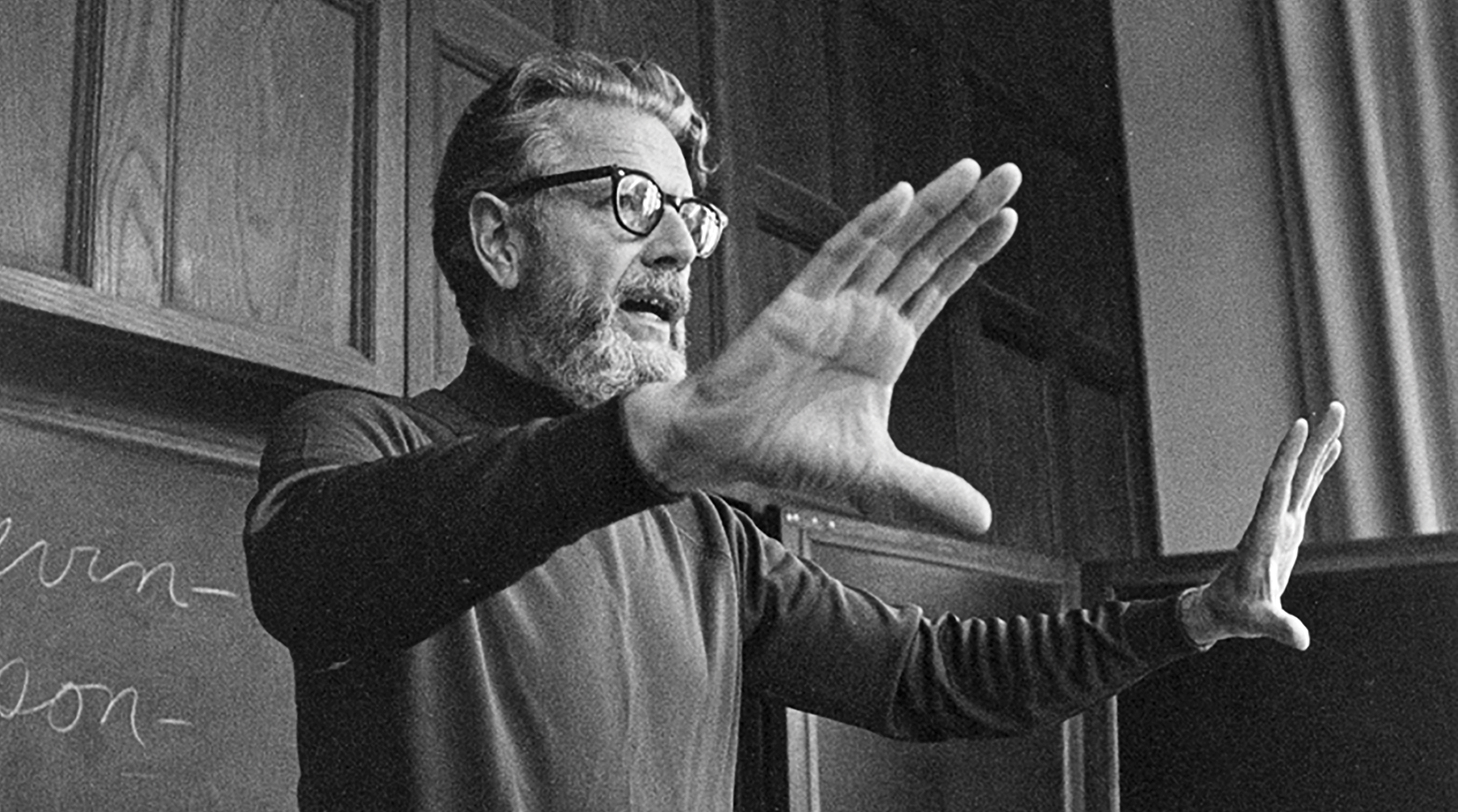
I was going to call this discipline “vanity,” but I thought that might be a bit harsh. You’ve got three or four minutes left in your writing moment. You’ve worked on your key sentence; you’ve said what you know; you’ve achieved the simplest statement that ten minutes of editing affords; and you have read yourself out loud. Time to wrap things up.
Remember that “perfect” doesn’t mean anything other than “finished” (from per–, “through”, and facere,“to do”: thoroughly done). There is no absolute standard of completing, there’s just getting the thing “done”. For now. That’s why it’s so important to leave your perfectionism only a few minutes to assert itself. Appreciate what you have achieved in its finitude, don’t be disappointed by everything you didn’t accomplish because you were not given unlimited resources.
In these last few minutes, immediately after reading yourself out loud, simply react to what you learned from that experience. Fix your spelling if that’s what struck you, what stung your vanity. Insert or remove a comma as necessary. Break up a long sentence that had you gasping for air into two sentences that skip like a stone on the still surface of a lake. Unmix a metaphor. Distill a concept into its essence. Address the issues that strike you as most pressing. Do what you like, but be mindful of the clock.
When it runs out, stop. You’ve then spent 27 minutes writing a paragraph about something you know. You should feel pretty good, pretty smart, but a little tired. You should feel like you’ve been put through your paces in prose. You have probably learned something, but it’s just a feeling for now. I’ll emphasize the point: you’ve done what you can. It’s not perfect but it is finished. You’re done with this paragraph for today. Put it behind you.
"Orality isn't and never has been the opposite of the written."
(Henri Meschonnic)
One way to approach the “meaning” of a text is as a set of rules for its performance. One way to interpret a text, then, is to imagine how it should be read out loud. This is what rhetoricians sometimes call the “immanent orality” of a text, the natural (or correct) intonation to give to a piece of writing, the tone of voice that expresses the writer’s intention. A given text may of course have a range of correct readings, and an even broader range of, let’s say, “possible” readings, i.e., readings that are reasonable given the words on the page but not what the writer actually had in mind. A good writer, however, gives the text a distinct, discernible “voice”. We might say that good writing clearly indicates the way it should be read out loud.
Let’s again take stock of your situation. You have just spent 22 minutes writing a paragraph. You have determined its posture and its content, and you have made it as efficient as you can. It’s time to consider its prosody — its melody and its rhythm. It’s time to find your voice. This is the sixth discipline.
There’s actually nothing to it. With five minutes left in your writing moment, you simply read the paragraph you have written, clearly and articulately, one word after another, out loud, just as you have written them. Say them like you mean them, of course. Or, rather, say them as you meant them, as you intended them to be spoken when you wrote them. If you’re describing something, even something abstract like a network or a graph, imagine it as you are speaking.
Reading your own text out loud is perhaps the best way to experience the quality of your writing. You’ll immediately hear (and even feel) whether your writing works. Good writing is easy to read out loud even when it is difficult to understand. When you read it out loud, you realize that your paragraph isn’t just an arrangement of meanings, it’s an arrangement of sounds too. It teaches us, as Mallarmé explained to Degas, that our writing isn’t made of ideas; it’s made of words. Big words and little words, arranged in short or long sentences, to come trippingly on the tongue, as Hamlet explained to the actor, not to be tripped over as you go. Reading yourself out loud reveals how well you’ve accomplished this.
If you do stumble, don’t worry about it, just pick yourself up and keep going. You’ve got a bit of work to do, it seems, but now is not the time for it. All you are doing at this point is experiencing your writing, its orality. Enjoy it. Or cringe at it. Either way, you’re learning something about your style. You are learning to empathize with your reader.
Image Credit: The Chicago Maroon &University of Chicago Library
Indeed, I owe my epigraph to a difficult but illuminating essay by the Canadian poet Lisa Robertson. In “The Prosody of the Citizen,” she argues that poetry is the beginning of our political lives because it establishes our conviviality, our being among others, in language. “‘Prosody,’ in this thinking, is the dynamic and specifically historical relation of subjects to language. […] For Meschonnic, poetry is the critique of the duality of the sign, and rhythm is the poem’s — and thus the subject’s — agency. It is only within such a continuously enacted critique that the subject can emerge as irrevocably ethical.” Wayne Booth called his book about the ethics of fiction The Company We Keep. By reading your paragraphs out loud, I want to suggest, by subjecting yourself to your own prosody, you are engaging in important ethical work. You’re learning how to be better company.
"What is the simplest possible statement?"
(Ezra Pound)
A paragraph is a composition of at least six sentences and at most two-hundred words that says one thing and supports, elaborates or defends it. Before you demand exceptions (which, by the way, I’m happy to grant), do note that this gives you a great deal of room to move. Six sentences that average 15 words each gives you less than a hundred words. That leaves you room for much longer sentences, and significantly more of them. Inverting the units, paragraphs will often be between 100 words and 12 sentences long. This should not feel like a set of constraints but like a space of freedom. Enjoy it.
Let’s recap how we got here. In the evening the day before, you did two specific things. You decided what you wanted to talk about and what you wanted to say. Then, twelve minutes ago, you sat down and spent two minutes getting your key sentence in the right rhetorical posture, making sure that it made a statement that required support, elaboration or defense. You then spent 10 minutes knowing the shit out of it (as the kids say), providing that support, elaboration or defense, writing sentences that made it easier to believe, understand, or agree with. You have 15 minutes left in your writing moment.
The fifth discipline is simplicity. Your task now is to make sure that your paragraph does what it needs to do with the greatest possible elegance and economy. The preceding ten minutes may well have produced 230 or 250 words. You need to remove some of them to get your paragraph down to the allowed length. (Or, if you insist, you need to earn the length you think you require here. I’ll say more about that at another time.) Often, there will be claims made in this paragraph that you can now see would be best left for another paragraph. Sometimes you will simply have said the same things twice or even thrice, without making the ideas easier to understand. Sometimes you’ve gotten all the right ideas down but in the wrong order, whether logically or temporally. You have ten minutes to fix these issues.
One important thing to look for at this stage is the needless use of technical jargon or pompous verbiage. Remember that your reader is an intellectual equal. Use words that convey your meaning in a way that you yourself would understand, easily and directly. Make sure that technical terms in your writing serve the specific purpose they were designed for. In a given paragraph, they may be used only once or twice. Also, remember that scientific language is mostly ordinary language with some added jargon that labels the switches and dials of specialized equipment. At the end of the day, you’re telling your reader what you did and what you saw. In most cases, if there is a plain-language way of saying something, that’s the one your reader will prefer. A good test here is: is it the one you would prefer?
In any case, you have ten minutes. That is, you’re giving yourself as much time to simplify your language as you did to gather your materials. I should say, however, that I’m not suggesting you time yourself very strictly; if you spend a little longer on the fourth discipline than the fifth, that’s fine. But keep the two of them together at 20 minutes, otherwise you’ll find yourself pressed for time for the last two things you need to do. But giving yourself specific amounts of time for each task, even rough amounts, is a good way to free yourself up to work on the discipline as such, without mixing in other concerns. You want to be able learn from the experience. Also, you’re always working on “discipline zero” — the art of stopping and moving on to the next thing. Don’t get stuck.
"Through the night, through sleep, the subconscious
works with the characters. They're alive again
in the morning. You understand? Ready for work."
(Ernest Hemingway)
We have made three distinct moves in preparation for this moment. The day before, we spent five minutes deciding what to write about and what to say about it. Two minutes into our writing session, having spent those minutes establishing the rhetorical posture of our key sentence, we’re now, finally, going to start doing what most people think of when they think of “writing”. We are going to spend ten minutes writing between five and ten sentences that support, elaborate or defend our claim. We are going to tell our reader what we know in order to help our them overcome the difficulty of believing, understanding or agreeing with us. Or we are going to tell them why they should be as excited about this fact as we are.
If you have made the first three moves in a serious and disciplined way (which takes some practice, so don’t worry if you haven’t the first few times you try it) this will not be especially difficult for you. After all, already yesterday you knew what you’d be saying now. You felt the dignity of an iceberg beneath you as you were deciding what to write about in the morning. All that should be happening now is that this feeling is becoming a series of thoughts, statements that are easier to believe, understand or agree with than your key sentences, and which, together, imply it. These are your reasons to hold the view you’re expressing and you’re simply making them visible to your reader. If you really have decided to write about something you know, these sentences should come quickly and naturally to you. Your subconscious was preparing them for you while you slept.
If you’re struggling here, you should not, of course, give up. But do note that the problem isn’t really one of writing. During these ten minutes, your problem is simply knowing the material, and if you’ve chosen your key sentence wisely, this isn’t a problem at all. So, while you shouldn’t beat yourself up, do chide yourself a little for picking the wrong thing to write about, something you don’t actually know well enough. You made a bad decision if this is very hard for you. But you’re stuck with it, so you may as well enjoy it. Use these ten minutes to explore the depth and the breadth of your ignorance. Be comfortable with not knowing — write to expose your ignorance if that is what it takes — but don’t give up, don’t stop. Usually, if you tough it out, you’ll realize that you’re not completely ignorant. You’ll come up with something.
The more you develop these seven little disciplines the more you will enjoy especially this one. This is where you feel your mastery over your materials. Here you are a musician in control of your instrument, a carpenter letting the saw do the work, a boxer absorbing and delivering familiar blows while sparring, a dancer in step with your partner. The sentences seem to write themselves, arranging words whose meanings are familiar to you, referring to things you have experienced, and asserting claims feel certain are true. Everything you say, you are able to imagine. You can see the scenes before you with your mind’s eye. You make yourself pictures of the facts and write them down. You know what you are talking about.
The third discipline is the act of sitting down in front of the machine at the appointed time to begin writing the paragraph you decided on when practicing your first and second discipline the day before. It’s important to understand the situation: before going to bed you knew what you were going to say and when you were going to say it. Your plan is to write a single paragraph starting at some exact moment, like 8:00 AM. You know what the key sentence of that paragraph is and that it expresses something you are knowledgeable about.
In a literal sense, you show up in front of a blank page, but, since your mind is prepared, there is no ambiguity about your task. When the writing moment begins, just type the key sentence. Do it slowly and deliberately, allowing yourself to modify it if you think this will make it clearer to your reader.
Now, consider why your reader needs a whole paragraph about this subject. Why can’t you just leave it at the one sentence? Why do you need at least five more? This must be because the reader faces some particular difficulty when the sentence is left there on its on. It may be hard to believe, hard to understand, or hard to agree with. (Sometimes, it may be boring — the fourth difficulty — but that’s an interesting problem too.) The third discipline is all about posing the problem effectively. Write the key sentence in such a way that it presents the difficulty that your knowledge will allow you to solve. Direct the sentence at your reader in a particular way from the center of your own strength.
All of this occupies only about two minutes of the writing moment and you are working on a single sentence, which may not even be twelve words longs. You are choosing those words with particular care. You are adopting a rhetorical posture, comporting yourself in a deliberate way, in order to signal to the reader what posture they should adopt too. Once you see yourself and your reader squared off (like two boxers or two dancers, as you choose) move on the fourth discipline.