Category Archives: Uncategorized

The Two-Dimensional Page

Gottlob Frege, Begriffsschrift, 1879
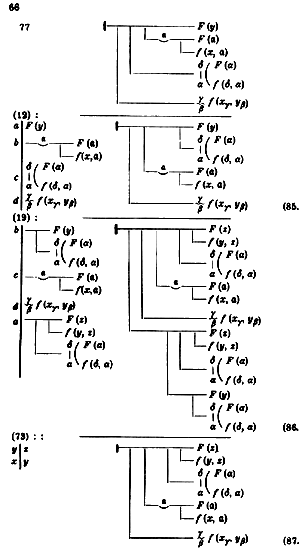
Image source: Frank Hartman)

When I started writing papers at university, I fetishized the visual impression of the page. This was in the 1990s, relatively early days of word processors (I was using Word Perfect), and I spent a significant amount of time worrying about font, spacing, margins, and layout. I liked pages that included a paragraph break or two and, if possible, a block quotation. I sought to have one every other page or so, simply for the look of “scholarly” prose. I also liked footnotes, and the air of erudition they immediately suggested. Even as a PhD student, I recall writing entire papers simply to earn the right to use a clever footnote I had thought of. (These papers never amounted to much more than stylistic experiments, of course.) I don’t recommend this fetish to students starting out today, but I’m sure it’s still common, and it can be a legitimate part of what George Orwell called the “aesthetic enthusiasm” of writers. If it gives you pleasure (real pleasure), by all means, enjoy the layout of the page.

In 1879, Gottlob Frege published a peculiar book called Begriffsschrift. The title is translated variously; I settled on Conceptual Notation long ago. His aim was to present the content of our thinking in a more “perspicuous” way than words normally allow. To this end, he proposed to use “the two-dimensional extension of the writing surface” to foreground the conceptual relationship between propositions, their logical interdependence. I’ve provided a sample at the top of the post so you can see what it looks like; the idea is that truth flows through this system, somewhat like a circuit. Once you have understood his notation, you can analyze your thinking in terms of the consequences of the truth or falsity of individual propositions on other propositions. “A good notation,” said Bertrand Russell in his introduction to Wittgenstein’s Tractatus, “[is] almost like a live teacher … and a perfect notation would be a substitute for thought” (p. xviii). One can decide that it is hyperbole, or that nothing is ever perfect, but Russell’s remark definitely captures the spirit of Frege’s project. If we could write our concepts down in a perfectly “surveyable” manner, he thought, the surface of the page would do the thinking for us, like a computer circuit calculates a sum for us inside our calculators.

Orwell was right to identify the page itself as an object of desire for writers. “[They] may feel strongly about typography, width of margins, etc.,” he said. And he was right to describe this feeling as “aesthetic,” meaning roughly what art critics mean by that term. I’ve always felt that that beauty is an experience that improves experience. I tell myself that that this is a “pragmatic” approach to art; the purpose of visual art is to make us see better, of music, to make us hear better, of poetry, to make us feel better. A beautiful page is not only easier to read, reading it makes us read better, makes us better able to discern the texture and cadence of the words we use. A messy, ugly page (like, in my opinion, those of many textbooks) is destructive to our sense of text, just as bad architecture and industrial noise disorients the senses and wears us down. If good notation is like a live teacher, a beautiful page is like a good friend. We enjoy the company independent of what is being said. It’s like someone speaking in a pleasant, familiar tone of voice.

As far as I’m aware, Frege didn’t speak directly about the “beauty” of his notation. But he must have felt some analogue of Orwell’s “enthusiasm” for his lines and functions. Many logicians and mathematicians find their formulas and equations beautiful, which partly explains their choice of vocation, of course. Just as a good poem might help you feel better — not happier, mind you, but more precisely happy or sad — a good conceptual note will help you think more clearly about something — clarity feels good to a logician. And if it doesn’t actually manage to replace your thinking, learning a system of notation will help you organize your thinking in general. It will improve the rigor of your “scientific experience”, allowing you to pass more easily from observations to implications, from premises to conclusions. If that doesn’t give you pleasure, research may not be the right career for you.

But as I hinted in my last post, this aesthetic project, whether philosophical or poetic, may be taking a bit of license with space and time. In prose, we have only one dimension — the order of words passing forward in time. Using this highly restricted medium (and Frege, remember, said that his notation was intended to do something that was not possible with words) we can conjure up the entire four-dimensional universe of ordinary experience, not to mention the higher dimensions of the quantum multiverse. Prose is capable of representing (in its way) virtually anything. When poets space out the words on the page, or use enjambment, or even resort to calligrams, they are, like Frege, exploiting “the two-dimensional extension of the writing surface.” They are using language more freely than is allowed in prose, which moves forward only along a single line. In a sense that I will return to in another post, they are cheating. They are using tricks and devices that go beyond the resources of scholarly prose. The results are often beautiful, and even at times useful, but they are not prosaic. I will leave for later the question of whether these aesthetic concerns are ancillary to our research, or merely incidental, but they are not, I want to insist, the substance of academic writing.

One-Dimensional Prose

“I don’t transgress against this order of things; I merely disperse its elements” (Stéphane Mallarmé, quoted by Jan Mieszkowski, Crises of the Sentence, p. 167.)

We experience ordinary life in four dimensions. Things are either near us or far away, to the right or to the left of us, above us or below us, before or after the present moment, which is simply where, when, and who we are right now. Henri Bergson said that “time is that which keeps everything from happening all at once”; space, we might say, keeps everything from piling up in the same place. We use these categories to keep things orderly. Some things we leave for later and others we leave in the past. Some things we keep close, while we hold others at a distance, and some things, finally, are neither here nor there.

Sometimes we make pictures of things. In Danish, a sculptor is a “picture carver” (billedhugger), someone who carves images out of stone. We can think of this as the removal of a dimension. The sculptor “captures” a living, four-dimensional human being in a moment in time, reducing them to a three-dimensional object. Of course, it’s not really three dimensional. It is still subject to the passing of time, but it is time as “experienced” by a block of marble — geological time, we might say — barely perceptible to the human eye. We can now take our time when we gaze upon its surfaces, which don’t change. We can walk all the way around the sculpture and return to the place we started. We can stare at it at as long as we like. It won’t move.

The painter, removes another dimension, fixing our perspective. Except in special cases, we can walk back and forth in front of a painting, step forward and step backwards, and we’ll see nothing more. The painting itself will usually indicate an ideal point from which to view it. (In some tricky cases, it will indicate two or more.) All other positions only let us us see it more or less badly. We may stand too close or too far away. We may look at it from too far above its horizon or too far below, too far to the right of its vanishing point or too far to the left. But everything is there on the surface.

What about the writer? I want to suggest that the writer works along a single dimension — a line — but not in space. Just as the viewer of a statue is free to move in space, but is frozen in time, and the viewer of the painting is free to stare as long as they like but is glued to the floor, the reader has been completely liberated from space, but is compelled to move forward in time, reading one word after another as determined by the writer. Time, as we all know, only goes one way. You can’t, meaningfully, read a text backwards because the rules of grammar are like the rules of perspective. You can break them but then the “work” is no longer available to you as the artist intended. You will no longer be reading a text if you let your eye wander freely, as you would when viewing a painting. Frankly, you’re not appreciating what the writer has tried to do.

I’m not entirely sure this is true, but I sometimes think that sculpture is easier than painting, and painting easier than writing, because the sculptor has more dimensions to work with, the painter less, and the writer only one. The sculptor represents four-dimensional experience in three dimensions, the painter reduces four to two, and the writer must capture all of time and space in the most fleeting dimension of them all. The reader can’t just keep staring at a sentence to get more out of it. The reader can’t go backwards to see if that will help. All the reader can do is read it again, experience the sequence of words exactly as before, hoping, perhaps, there was something they missed. They can then stop or go on to the next sentence, hoping that will clear things up. Good luck, dear reader.

I’m going to develop this idea further in the posts to come. I suspect it only holds, if at all, for prose — and probably only for a rather conventional kind of prose. (Just as our “modern” painters have been subverting our perspective, our poets have been liberating our “feet”.) But conventional prose, after all, is all that this blog is trying to get to the bottom of: the craft beneath the method — not the method in the madness — of scholarly writing.

Imagination

“We make ourselves pictures of the facts.”
(Ludwig Wittgenstein)

I want to end this series of posts where we started, with the peculiar human faculty of imagination. I have lamented its marginalization in scholarly writing before, and I often daydream about its return to the center of our attention. Without imagination, there can be no understanding; without understanding, there can be no believing; and without belief, there can be no knowledge. In this sense, it would be correct to say that the faculty of imagination sets a “transcendental” limit to our knowledge of things. We can’t know something we can’t imagine. So you do well to find out whether you can.

Remember what Ezra Pound said about artists: “The serious artist is scientific in that he presents the image of his desire, of his hate, of his indifference as precisely that, as precisely the image of his own desire, hate or indifference. The more precise his record the more lasting and unassailable his work of art” (Literary Essays, p. 46). These images are what he called “the data of ethics,” and it is my assertion that they also constitute the data of epistemology. They are produced by the artful exercise of imagination and are then given to the intellect for analysis. In fact, we can say that serious scientists are artistic, presenting us with images of their (justified, true) beliefs. (Vladimir Nabokov once recommended his own “rain-sparkling crystograms” to “serious psychologists” for study.) In their writing, scientists “build us their worlds” in our imaginations.

“Beauty is difficult,” said Aubrey Beardsley to Pound. But in a certain sense the image is easy — you just peel it off the appearances. It is, in any case, easier to believe something than it is to know it; it is easier to understand something than it is to believe it; and it is easier to imagine a thing than it is to understand it. The beauty of imagination lies in the way it lets us bring elements together that we don’t yet understand, so that they can shed light on each other. That is how we learn things. Of course, they also cast shadows, and it is probably more accurate to say that we arrange things in our imaginations in order to adjust the light. When we get it right, we understand them. It is a thing of beauty to behold.

I hope I’m not coming off as too much of a “romantic” about this. But I am indeed trying to emphasize that research has an “aesthetic” dimension. The beauty of your research should come across in your writing; there should be a feeling associated with what you know. And you should share that feeling with your reader.

We are conditioned to think that, beyond getting your theories and methods right, academic writing is all about referencing conventions and rules of grammar. There are dark moments, when we suspect that the only relevant feeling is boredom. But we should never forget, as Borges warned us long ago, that “a book is more than a verbal structure or series of verbal structures; it is the dialogue it establishes with its reader and the intonation it imposes upon his voice and the changing and durable images it leaves in his memory” (“A Note on (toward) Bernard Shaw”, Labyrinths, p. 213). As you struggle with the “formality” and “correctness” of your research paper, don’t forget that you are engaging with the reader’s imagination. They should see a picture. They should hear a voice.

Generalization

"Any general statement is like
a cheque drawn on a bank."
(Ezra Pound)

To generalize is to promise specifics. If you are going to say that all swans are white, you’re going to have to produce at least one white swan, and you’re going to have to be open to examining the color of other people’s (preferably randomly chosen) swans. Your statement isn’t just about swans “in general”; it’s about every certifiable swan on the planet. Most importantly, if someone brings you a black waterbird, you had better be prepared to discuss whether it’s a swan or some kind of duck. Indeed, your statement applies to every bird of any color. If the bird is a swan, you’re saying, it’s going to be white; if it’s not white, it is not a swan. Maybe you’ve already guessed where this is going: your generalization actually applies to every blesséd thing, which, you are saying, is either white or not a swan, but never not white and also a swan. “All swans are white,” that is, also depends, as so much does, upon a red wheelbarrow, which isn’t even a chicken.

Now, as it turns out, there are black swans, both literally and figuratively. (There are even ugly ducklings.) So it would be more accurate, perhaps, to say that most swans are white, or that adult mute swans (Cygnus olor) are mostly white, while adult black swans (Cygnus atratus) are indeed mostly black. If you’re familiar with Toulmin’s model of argumentation you will immediately recognize these as qualifiers that define the strength and scope of your generalization. You are making it clear exactly what your generalization means, what it can be used for, and, in fact, how useful it is likely to be be. You are gerrymandering its meaning to maximize its truth, we might say.

A pragmatist will tell you that “the truth is what works,” and this is no less true of generalizations than statements of particular fact. The interesting thing about generalizations is that they “work” in so far as they are right about those particular facts, and often ones that we haven’t yet observed. These are the specifics I said you owe your reader every time you make a general statement. You don’t have to pay your debt in full in the paper itself (and, in a sense, that isn’t even possible), but you are implicitly claiming to be able to “specify” the meaning of your generalization with reference to some unambiguous matters of fact. This is often couched in the language of “making predictions”. The general statements of your theory predict the specific statements of your hypotheses, and it should even let your readers make predictions — i.e., frame hypotheses — of their own. They theory “works” if it gets those predictions right.

Of course, we don’t submit all our generalizations to rigorous testing like this. I am just trying to make clear what we mean by general statements, namely, that a range of specific statements are true. When you say something of a general kind, you usually imply that you have access to specifics, that you have experienced the relevant particulars. You are also claiming that if counterexamples exist you would have been likely to have seen them. So make sure that you are able to construct examples as well as counterexamples of the generalities you invoke in your writing. You never know when someone will take you seriously enough to test you. You want to be ready when it happens.

The value of a general statement, said Ezra Pound in the ABC of Reading, “depends on what is there to meet it. If Mr. Rockefeller draws a cheque for a million dollars it is good. If I draw one for a million it is a joke, a hoax, it has no value. If it is taken seriously, the writing of it becomes a criminal act” (p. 25). Sometimes it’s an honest mistake, of course; you thought you had enough money to cover it. But sometimes you know full well that the bank will not honor your check. In scholarship, the same thing can happen. You may have looked at a lot swans, but never gone to Australia. Or you may just be passing along what you were told as a child. Or you may be perfectly aware of the Australian black swan and just hope that your reader never goes there. Some scholars generalize based on nothing more than hearsay and gut feeling. Some scholars overgeneralize from observations that they haven’t made enough of. And some scholars simply fabricate their results, writing checks they know their data can’t cash.

I don’t think you need my moral guidance here.

Examination

"Every man has the right to have his ideas
examined one at a time." (Ezra Pound)

Even very established scholars sometimes describe themselves as “students of” their subjects. This isn’t an expression of (even false) humility; they are merely acknowledging that they “study” things. Something similar can be said of words like “test” and “examine”, which can be applied both to people and to ideas. At first pass, these seem to be radically different senses of “student” and “examine”, but I think it’s worth noting their connections. Students and scholars are, after all, engaged in the same cultural activity, namely, “learning.” Though here, again, we’re tempted to say that the word is used in two very different senses, I think it’s important to keep in mind that, not only is our instruction based on our scholarship, we are, in part, instructing our students in the craft of scholarship. Examination is an integral part of academic life, even when it’s not part of the process of assigning a grade.

That said, I sometimes suspect that scholars resent the exam-like conditions of, for example, the peer-review process. While it makes sense to want to put “school” behind you, that desire is easier for people who leave the university (for one of the professions or the arts or anything else) to declare than it is for academics to wanly announce. In fact, academics ideally chose their career path because they genuinely respect the exam situation. We might say that the university ought to attract people who, precisely, don’t resent examination, i.e., people who see the value of testing the knowledge of someone whose job it is to know things. The deepest way of addressing this problem, then, is to explain why no one, not even a student, should resent being examined.

Why are exams a good thing?

We can begin with the easy cases. We want our doctors to know what they’re doing. We want them to get very good educations, and we want their licenses to practice medicine to depend on this education. We’re not satisfied with their merely getting into, or even dutifully attending, medical school. We want to know that they actually learned what their teachers were trying to teach them. So we expect those teachers to examine our future doctors’ understanding of the current state of medical knowledge. These days, many of us are discovering (some of us, to our surprise) the depth of our respect for medicine, and this implies a respect for the institutions that train our medical professionals. We believe that they’ve done a good job of ensuring that the people who treat us when we are ill know what they’re doing.

This is why I don’t like it when established academics side with students who “hate school” (allegedly out of their “love of learning”). It’s perfectly legitimate, and often no doubt reasonable, to dislike going to school. All social institutions are imperfect, and none can fulfill its mission entirely without some residual nuisance and boredom, but higher education is for people who have actively put up with those imperfections for the sake of a greater goal, indeed, a higher purpose.

Testing a student is merely a somewhat artificial instance of testing ideas. Ezra Pound invoked his “right” to have his ideas tested (he had his reasons), but there is also, among academics in any case, a duty to let them be tested. At the limit, we might posit a Socratic duty to oneself to examine one’s own ideas, lest one’s own life be not worth living. But, as I reminded us above, the unexamined doctor is certainly not worthy of a medical practice. Highly educated professionals deserve our respect because they once allowed themselves to be examined by people who were qualified to tell them they were wrong. Academics, I never tire of saying, are people who are permanently committed to this regime of “testing” by their peers.