Category Archives: Uncategorized

The Place of Forms and the Form of Life

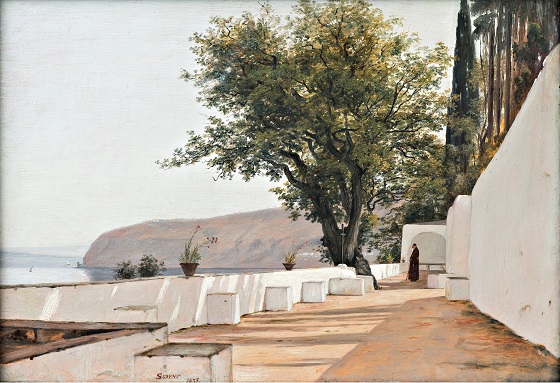
Martinus Rørbye, Scene Near Sorrento Overlooking the Sea, 1835. (Source: Nivaagaard Collection)

Words only have meaning in the context of a life. Your words matter to me not just because they matter to you but because I use those same words to similar ends. We are here with each other, each in our own way. Our words, Heidegger pointed out, are part of the “equipmental contexture” of our existence; even our most theoretical pursuits are subject to our moods and require material resources. Our language is invested with the significance of the things and people we rely on to carry on our work.

Heidegger also taught us that human existence (Dasein, being-there) is a “place of forms” (topos eidon in Greek), a locus of ideas, a site of meaning. All of us are meeting places for ideas, our own and always also those of others. And, as William Carlos Williams famously said, there are “no ideas but in things”, i.e., ideas come to us in the significance of the things we find in our environment. We are simply the clearing in which they come to light. Our words are illuminated by this significance, just as our lives are. When we write we share that light with others.

“To imagine a language is to imagine a form of life,” said Wittgenstein. Much of his work consisted of getting us to imagine various “language games”, i.e., activities in which words might be used in particular ways and in which their meaning would arise out of their use. “Speaking a language is part of an activity, or a form of life.” If that activity involves tools and materials of various kinds then those things (and the way we use them) will contribute to the meaning of the words we use (and the way we use them). To make myself understood by you I must understand your form of life.

Writers must discover this again and again. Kenneth Burke approached literature as “equipment for living”; Roland Barthes argued that “writing is essentially the morality of form”. “A writer’s problem does not change,” said Hemingway, “He himself changes, but his problem remains the same. It is always how to write truly and, having found what is true, to project it in such a way that it becomes a part of the experience of the person who reads it.” That is, the writer must find a way to arrange words such that what they mean in the context of the writer’s life remains when they are thrown into the context of the reader’s life.

Technical language (the language of the sciences, for example) is really just ordinary language used in the context of some specialized equipment. The language will include the names of the dials and switches on the machines we use to engage with the world and the instructions for using them correctly. This includes things like “interview transcripts” and “intercoder reliability”. To the right person, which is to say, the person who leads the right kind of life, properly trained in the methods we deploy, these concepts are meaningful in the ordinary way. Their “meaning is use,” as Wittgenstein might put it.

The words in this post, too, are only meaningful in the context of a particular kind of life. “Yes, the life of a philosopher!” you might say. Fair enough; I suppose I’m being a bit philosophical, and these words will only matter greatly to someone who is interested in such things. But all academics, to a certain degree, are invested in philosophy; and academia, too, is in any case a form of life. It can be useful to have a look around the place now and then, this place of a particular set of forms, this locus of a particular class of ideas. They are “in things” too. Try to find them. They are very close at hand, I promise you.

Clearing the Ground for the Place of Forms

Heidegger and Wittgenstein were both profoundly interested in the way language shapes experience. I have tried (somewhat less profoundly) to follow the way of this shape in my own work as a writing instructor and coach. About ten years ago, for example, I admonished the readers of my old blog to take metaphysical responsibility for their craftsmanship: scholars don’t (or shouldn’t) just “hustle and bustle” to “publish or perish”. Their work, literally, “keeps the real in place.” Lately, I’ve been thinking more about this.

Gaugin, “Clearing II”, Source: Wikimedia Foundation

Heidegger thought of human existence as a “clearing” of being, an opening in the brute “facticity” of the world that lets in the light of nature (the lumen naturale). Our existence is not merely a “presence at hand” like all the other things in the world. We are not just “extant”; we are here. In fact, our existence produces the “here” into which we are thrown. Without us there would be nothing. Technically, I suppose, the whole universe would still “be there”, just not here. It wouldn’t be anywhere; there would be nowhere for it to be. Existentially speaking, if you will, the universe wouldn’t exist without us. Or it at least it wouldn’t mean anything because we are the site of meaning, the place of forms. Language, as Heidegger put it, is the “house of being”, so without us, without our presence as “discursive creatures”, the universe would be homeless — meaningless, empty.

Wittgenstein offered us another way to think about this situation. To help us understand what a language is, he employed a number of metaphors, the most famous of which, perhaps, is the idea of a “game”: language is a game we play with words. He imagined one such game played by builders who use words to give each other instructions:

The language is meant to serve for communication between a builder A and an assistant B.  A is building with building-stones; there are blocks, pillars, slabs and beams.  B has to pass the stones, and that in the order in which A needs them.  For this purpose they use a language consisting of the words ‘block’, ‘pillar’, ‘slab’, ‘beam’.  A calls them out; –B brings the stone which he has learnt to bring at such-and-such a call. — Conceive this as a complete primitive language. (PI§2)

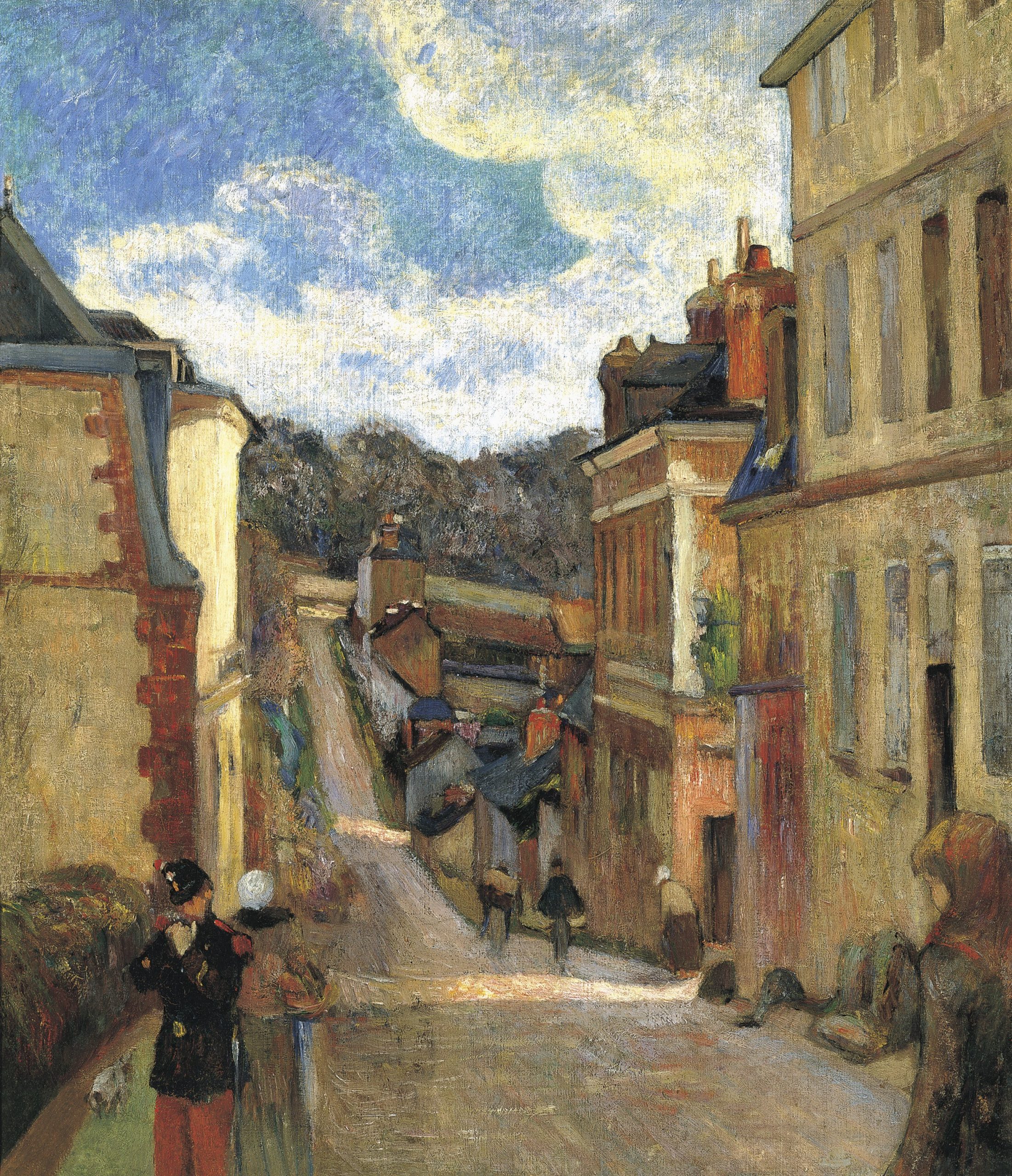
Gaugin, “Rue Jouvenet, Rouen”
Source: Museo Nacional Thyssen-Bornemisza

To fill in an association here, let us imagine that these builders end up building a town, which grows into a city. This leads us to another of Wittgenstein’s metaphors:

Our language may be seen as an ancient city: a maze of little streets and squares, this surrounded by a multitude of new boroughs with straight regular streets and uniform houses. (PI§18)

Gaugin, “Rue du Nord, Rouen“, Source: Wikimedia Foundation

But it is, of course, possible to get lost in such a city, especially in the older, less regular parts of town, where the streets, perhaps, don’t even have names. “A philosophical problem,” said Wittgenstein, “has the form: ‘I don’t know my way about'” (PI§123). Philosophy helps us to “command a clear view of the use of our words”. But while he sometimes proposes to accomplish this merely through the “perspicuous presentation” of ordinary expressions, providing a “synopsis of trivialities”, he sometimes uses more, let us say, radical language to describe his process:

Where does our investigation get its importance from, since it seems only to destroy everything interesting, that is, all that is great and important? (As it were all the buildings, leaving behind only bits of stone and rubble.) What we are destroying is nothing but houses of cards and we are clearing up the ground of language on which they stand. (PI§118)

That’s quite an image! I guess it rivals Heidegger’s “destruction of the history of metaphysics” in its sheer catastrophism. But perhaps philosophy leaves behind not just stone and rubble. Perhaps, after clearing the ground of language, we still have those blocks and pillars and slabs and beams that Wittgenstein’s builders can play with. Something to rebuild our world from. Maybe there is some hope in philosophy, after all; maybe by thinking about the foundations of existence and language we are clearing the ground for the place of forms?

Students and Their Style

“The more ignorant a writer feels, the more artificial becomes his style.”
(Cyril Connolly)

Let us consider the student’s predicament. Students are those members of our community who enroll in classes and attend lectures and complete assignments and sit for examinations, all in order, finally, to receive degrees. Though we preach the value of learning for its own sake, we give them many other reasons to learn the material we put before them. They may be called on in class and be embarrassed by their lack of preparation, they may submit an assignment and be disappointed by their grade, or they may graduate and find themselves competing with people more knowledgeable than they are. Or they may be proud, or happy, or victorious in these situations. Either way, the value of learning isn’t purely intrinsic.

Our students expect that the education they receive will play a role in their future success, in their pursuit of wealth and power. (Let’s not moralize about these basic ambitions. Perhaps they know that true wealth lies in knowing when you have enough and perhaps they seek power only to let them make the world a better place.) Whatever their extrinsic motivations, all we can do, as their teachers, is to impart knowledge. But we, too, are bound, by our obligations to society, to certain extrinsic values; we must reward our students for what they learn and punish them for that they don’t. So, like it or not, we give our students an incentive to pretend to know more than they really do, to present themselves for examination more confident than they really are. In short, we can’t help but make them feel a little ignorant when they write — less knowledgeable than they think they ought to be. “Just be natural,” doesn’t seem like a viable option when writing a term paper.

Cyril Connolly devoted the first third of his Enemies of Promise to “the predicament” of style. He was talking about the sort of thing that makes a book age well or badly. Style, after all, is often the means by which a book shows its age. A book can go “out of style” in this sense when the fashions change and its eloquence chafes against the “modern” demand for something more colloquial. We’ve all been students and had the experience of reading work from semesters past, cringing a little at the affected tone we thought was suitably “academic” or “scholarly” at the time. In hindsight, we recognize immediately that we were pretending to know more than we really did, and that we were vaguely hoping to get away with it. We were not opening our thoughts and feelings, our minds and hearts, to the criticism of people who are qualified to tell us we are wrong. We were trying to get our ideas across to our readers — indeed, past them.

Students often imagine that they are writing for their teachers and their examiners. You might think I’m using the word “imagine” strangely here, since, surely, they are in fact writing for their teachers and examiners. Well, yes and no. Their teachers are not really reading their work, since they have been put in the position of a judge — a position that they often resent as much as their students do. They do not really feel “addressed” by the students, except perhaps as the object of this shared resentment. But this situation is of course false; it is artificial, and it should be avoided if we can. The students should be writing for their peers, for people they respect as intellectual equals. Teachers should be judging them on their ability thus to address each other. Students should be developing a prose style that lets them share their thoughts with the brightest and most ambitious of their classmates. It is this conversation that their writing should contribute to.

This year, in any case, I’ll once again be telling students to address themselves to each other, with all the confidence and humility that this implies. They should get to know each other and they should choose their topics with each other in mind. They should weigh their claims so that their fellow students will find them just a little a hard to believe, understand, or agree with (in a word, interesting), and they should learn to write paragraphs that support, elaborate, or defend them accordingly. They should not develop a style that impresses their teachers but one that opens their own thinking to that of their peers. (Yes, of course, their teachers should be impressed when they succeed.) So they will have to make up their minds about what they are learning. They will have to speak their mind. And they will have to learn to write it down. That’s what I intend to tell them.

Writing Process Reengineering: The Course

During the lockdown I had a number of teaching experiences that I’m going to try to integrate into my attempts to impart Writing Process Reengineering to doctoral students and early career academics. In November, I will be running a four-week course here at the Copenhagen Business School, which will also have a “massive online”, if you will, presence. I thought I’d write a little post today about what I have in mind.

The course consists of three 3-hour on-campus meetings: an introductory seminar, a masterclass, and a capstone seminar. In between meetings, participants will do 20 hours of writing, but they can leave some of this for the week of the capstone seminar, which is on a Monday. At the end of the course, they should have a complete first draft of a journal article and 40 very explicit writing experiences. They will also have given and received feedback and discussed the problem of academic writing from philosophical, rhetorical, and literary perspectives; they will have been exposed both to the grand ideas of Writing Process Reengineering and its grimy little nuts and bolts. And they should depart with a good sense of how they can continue to implement it in their research and writing processes going forward, hopefully throughout a long and productive career.

As an ambitious explorer of media, I’ve decided to add a podcast element to the course. In fact, I’ve decided to organize it in such a way that a “podcourse” is available to people who can’t attend the live sessions. Participating in this way will require a little extra reading, but if they make a little effort, they should be able to get almost as much out of it as the flesh-and-blood participants.

This is something I learned from a writing course I co-teach in one of our master’s programs. The standard set-up is to meet with students for whole (8-hour) days separated by a few weeks. Moving these sessions online during the lockdown was quite exhausting for both the instructors and the participants, but it was not possible simply to shorten the days and have more of them. (Our professional master’s programs are designed for people who have an easier time devoting a whole day to study than taking a few hours out of their workday.) So we came up with an elegant solution. The last two hours of every day were organized around two pre-recorded 20-minute podcasts, each with a short exercise that could be completed within about half an hour. This allowed participants either to leave it for later in the evening, or even another day, or go straight to it (since they may already have freed up the time.) It offered a good combination of structure and flexibility.

To get them away from the screen, we encouraged participants to take the podcasts with them on a walk, and we even designed the exercises so that they could be done unaided by anything more complicated than a pen, a piece of paper, and their imaginations (in some cases, their imaginations were actually equipment enough). This is what I want to try to replicate for my course, but on a daily rather than semi-weekly basis.

Starting in early November, therefore, I’ll begin to post short 5-minute podcasts with reflections and exercises to prepare participants for the writing they will do on each (most) of the days between meetings of the course. There will be twenty podcasts in all, five days a week for four weeks. The idea is to listen to them as the last thing you do in your working day, just before deciding what you will write in the morning. I recommend you listen to them in a relaxed mood, perhaps while taking a walk. When the course is over, the twenty podcasts will remain on the course website, so you can take the course again anytime you want to devote some deliberate hours to getting better at writing. You just book some writing time into your calendar, and listen to a brief podcast at the end of each day.

I’m looking forward to seeing how well this works. Both as a supplement to the on-campus course and as a stand-alone podcourse. Any feedback, even at this early planning stage, is much appreciated. Let me have it!

[Read the full program and register here.]

Arts and Crafts

I’m back from my leave and looking forward to talking to scholars and students about their writing again. As always, I will be pursuing it as a “craft” that can be developed through practice. I’ve been putting the final touches on my main activities for this semester and I thought I’d share them today for those who are interested. You will notice that registration is open only to CBS students and staff, but if you would like to participate in something and are not part of the CBS community feel free to contact me to see if that might be possible. Some of these activities have an online option, and that will usually be a quite open channel. You can get an overview here.

As a new thing this year, I’ve decided to address some ordinary “pedagogical” issues. What can we do to improve ourselves as students, as learners? There’s a definite art to this, which is situated in some rather familiar conventional contexts, aptly captured in the title of Norm Friesen’s The Textbook and the Lecture, or what I sometimes simply call “the academic situation”. This situation provides a number of reliable resources for learning, and, of course, a number of dependable challenges to overcome. For example, it provides us with an orderly framework within which to think, which risks becoming a set of constraints on our creativity. We are encouraged to be precise, but there’s a risk that we’ll be bored. That tension is virtually constitutive of academia.

The “Art of Learning” series in the fall is intended as a kind of loose warmup to the more goal-oriented “Craft of Research” series in the spring. In the fall, we’ll talk about the various competences that together define what it means to be a “knowledgeable” person, what it means to have “learned” something. In the spring, we’ll bring these skills together in the work of researching and writing a year-end project or thesis. If a research paper is written “one paragraph at a time” an education proceeds through azure moments, “rooted in watching with affection the way people grow”. The talks will give me an opportunity to explain what I mean by this, not least to myself.

I don’t intend to make too much out of the distinction between “art” and “craft”, except that, to me, craftsmanship is more about the work that is produced and artistry is more about the experience that it produces. Somewhat clumsily, we might say that craft is more objective and art is more subjective. Craft is about whether the thing works, while art is about what it does to us. The reason they’re hard to keep apart, of course, is that a “work of art” works precisely when it moves us. And sometimes an encounter with plain old good craftsmanship is a transformative experience in itself. It’s a good thing I’ve a got a few weeks before I start, and many more to work though these issues one at a time!

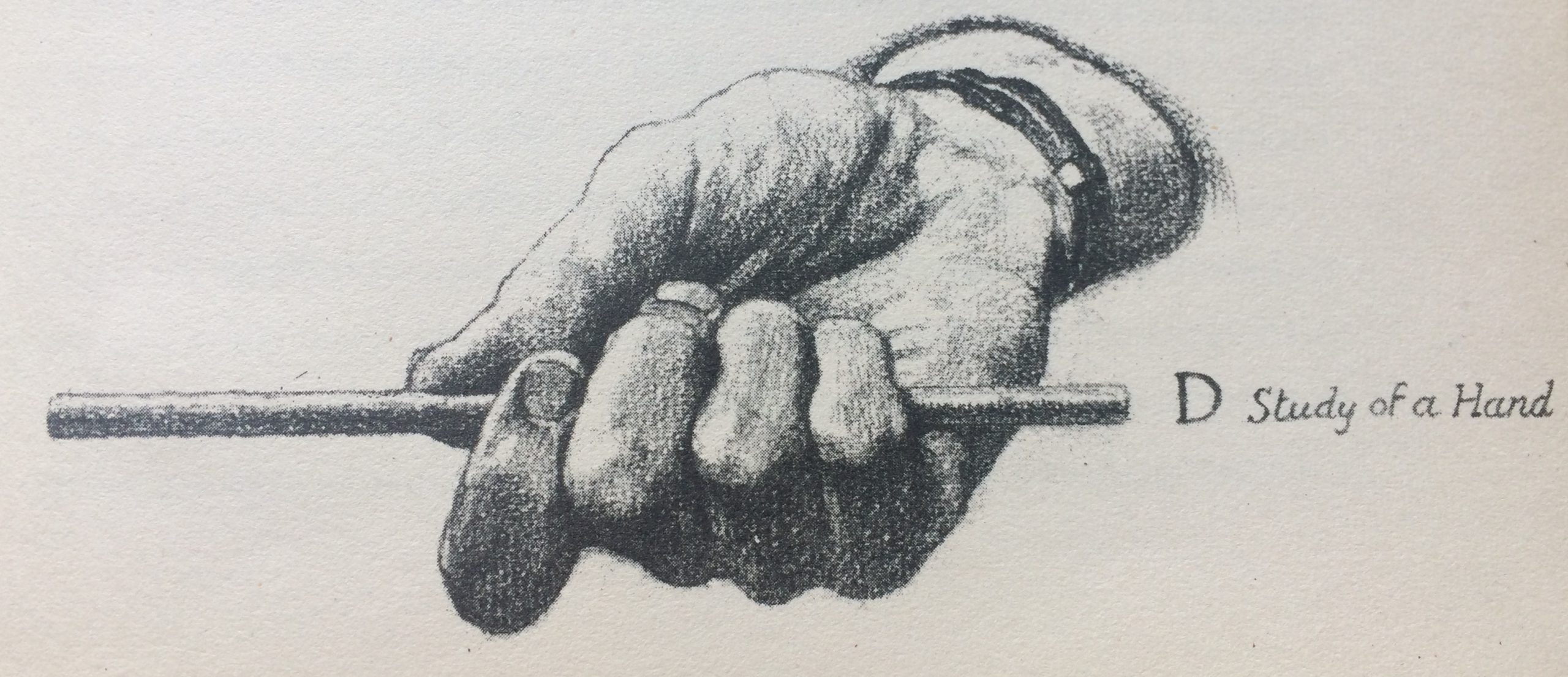
While I was on leave, I drew a lot of hands. My artist friend helpfully reminded me to draw, not what I know, but what I see. Even more specifically, she told me to begin with the shadows, not the lines. “The lines aren’t really there,” she said; “they’re just edges, where things end.” I have tried and tried but I’m still blinded by my knowledge from seeing my hand clearly. On some days I am proud of what I have accomplished, on others I am frustrated beyond consolation. On some days, I feel both emotions about the same drawing. I am far from mastering the craft of drawing anything, let alone the complex machinery of the hand. But I am learning.

“We suffer and we learn,” said Aeschylus. For many students, that’s all there is to it. You tough it out, you suffer through it, and you move on with your life. But what I want to suggest is that this suffering isn’t just what Oscar Wilde (writing from jail) called “one very long moment”. It is a series of discrete moments during each of which we find a specific kind of composure. We learn how to read and how to write, how to listen and how to talk, how to think and how, finally, to enjoy the whole business of knowing things, one experience at a time. We have to give ourselves the time to do this. We have to find a moment, and then another, and undertake to learn something from it. Under these conditions, guided by this discipline, I would argue that Whitman’s words hold true: “Whatever satisfies the soul is truth.”