Category Archives: Uncategorized

The Literature

“Appreciate your finitude.”

Each of us knows a great deal. And there is a lot that we don’t know but is known by others. These are the things we learn by doing our literature review. Many researchers find this task daunting and, in this post, I want to try to summarize the advice I give to them.

Begin with a small set of papers that you have a close connection to. You may have authored or co-authored some of them yourself, or you may have worked closely with the people who have authored them. They may be written by members of your department or people who have collaborated with your colleagues. Ideally, you have met the authors of these papers and have a good understanding of the sort of research they do. You have a concrete image of where they work and how they go about their research, and you are, of course, at least moderately impressed with what they have accomplished…

(Note: If you are a student, you will not, of course, have such an intimate relationship with these papers. But you’ll recognize them because they have come up in your classes, and you’ll sometimes get the sense that your teachers are familiar with them in this way. They are central part of the discipline you are studying or, more precisely, the specialty that the class is focused on.)

When you read one of their papers, you can form clear images of the facts they represent and you have a well-grounded opinion of how likely their results are to be correct. You don’t have to be entirely convinced of their claims. But you do have to find them interesting, and you have to respect the research they have done. This list of papers can be quite short; even two or three can be sufficient, but I would suggest finding between six and twelve. Put them at the center of your search.

Locate them individually in the various databases that you have at your disposal. Here at CBS, at would recommend you find them in Business Source Complete, Web of Science, and Scopus.* Once you have found the articles, look at the bibliographical data that the database provides for them; notice that there is an abstract, some key words, a journal, and of course the authors. These are all going to be useful to you when you are looking for similar articles, since “similarity” here is just a reference to the data that the entries in the database share with other entries. Using your awareness of these similarities, you will be able to design searches that quickly and accurately locate literature that is relevant to your research.

But the entries, especially in Web of Science and Scopus, also let you think of each article as occupying a node in a network of citations. In addition to the bibliographical data, an entry usually contains the full bibliography of the article itself (its reference list, its list of sources, its “cited references”). It also links to a list of “citing documents”, i.e., all the articles in the database that have this article on their reference lists. Finally, they give you the option of searching for “related documents,” which is a long list of all the articles that share at least one reference with the article in question. (These can be organized by “relevance”, i.e., in order of how many references they share.) With this information, you able are able to position an article in the discourse to which it contributes.

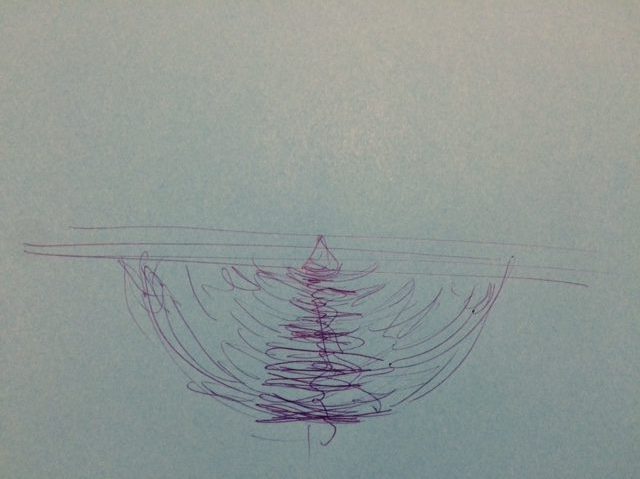
While a citation network may be large, it is not infinite. More importantly, it has a center and a periphery, as well as a past and a future. In the center is that short list of articles with which you are already very familiar and should be quite recently published. Behind them lie all their sources, which we can imagine as one long, shared bibliography; but, instead of putting it in alphabetical order, let’s arrange them by publication date, with the oldest at the furthest remove from your core papers. Also, let’s group them along a center line so that the papers that share references (or are otherwise topically related) are closest to each other, and those that don’t are further from the line. This will produce a sort “wake” trailing after the core articles and shading off into the “ocean” of published papers that are not directly cited but are nonetheless related to the articles you do cite. By a similar token, there will be papers that are contemporaneous with your core, and very relevant, but (since they were published at around the same time) will not cite your work (or that of your close colleagues). And there will be papers that are at quite a remove (either conceptually or bibliographically) from your core, but more or less related to the papers you cite, or the papers that are related to those you cite. An illustration might be useful:


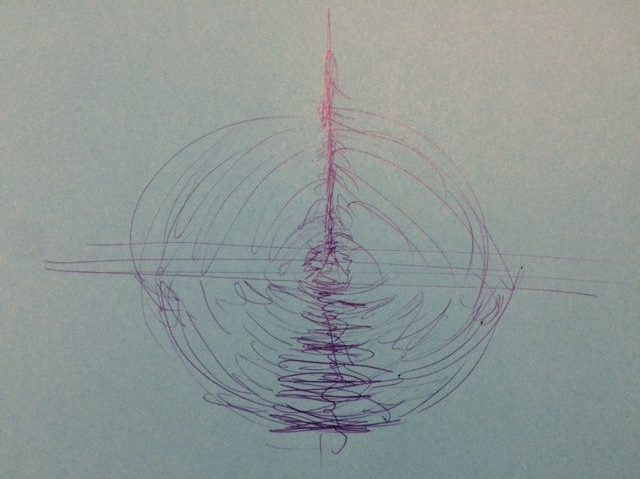
But nothing is entirely static in research. The literature is constantly growing and it’s important to have a way of navigating on the ocean of scholarship. Obviously, your own research (and that of those core peers, whose research you are very familiar with and probably read about in draft and pre-print form) will follow a line proceeding from the (present) center of your research. Closely related to this line will be (future) papers that cite your core articles (albeit sometimes just in passing) and, again, the (future) papers that are related to those articles by way of shared references. We now get a diagram that looks a bit like this:

The key to all of this is to appreciate the finitude of the problem. While there is a lot to know, there are only a handful of very relevant articles, and a manageable amount of less relevant ones, before we finally reach your research horizon, beyond which you can safely remain ignorant of what goes on (until you get there yourself, of course). The ocean is a big place, but you’re only ever sailing in some local part of it. Don’t be afraid today of what is really just part of the adventure tomorrow. “Here be dragons,” is a myth born of ignorance. Uncharted waters are just places you haven’t yet explored.

____________

*Update: Patrick Dunleavy, whose views on writing and publishing are always worth taking seriously, has taken me to task on Twitter for this recommendation, calling it “outdated”: “Leaving out Google Scholar,” he argues, “‘costs’ your advisees. They’ll miss all grey literature (pretty vital in business studies on new topics), plus all books, book chapters & most conference papers.” Jo Jordan came to my defense: “But starting them on Google Scholar,” she countered, “condemns them to muddle and an inability to use IT to manage their databases. Need to see some total costings here.” I think that gets it mostly right and it reminded me of what Bill Evans says about keeping things “simple and real”. That’s the spirit in which I wrote this post. But I’ll have to write one specifically about Google Scholar at some point.

Philosophers and Poets

Wittgenstein said that “the civil status of a contradiction” is the philosophical problem (PI§125). The philosopher’s problem is to sort out how we got into a contradiction and how we might proceed — how we “can go on,” as he put it. Following Ezra Pound, I have long argued that the poet’s problem can be expressed analogously as “the civil status of seduction”. In his writings on the Troubadours, Pound argued that they struggled to find fit words to express the sufferings of lovers otherwise embroiled in a variety of ambient intrigue, including their, let us say, official or “civil” unions, their formal marriages. “Courtly love” was the sort of passion you could pursue in a royal court, while observing your official duties. “Official wisdom”, we might say, is the logic of mainstream science. Poets and philosophers, in any case, use language to make the complexities of civil, public life explicit. They make them subjects and objects of discourse.

So, just as you can think of yourself as a “boxer” or a “dancer” when writing, perhaps you can think of yourself as a philosopher or a poet. In fact, there may be some natural overlap between these categories. Boxers, let’s say, “contradict” each other, while a dance is always at some level a “seduction”. A philosopher is trying to “win” the argument by arriving at some truth at the end of a deduction or chain of reasoning. I will leave it to Ezra Pound to explain the problems of the thirteenth-century troubadours:

After the compositions of Vidal, Rudel, Ventadour, of Bornelh and Bertrans de Born and Arnaut Daniel, there seemed little chance of doing distinctive work in the ‘canzon de l’amour courtois’. There was no way, or at least there was no man in Provence capable of finding a new way of saying in six closely rhymed strophes that a certain girl, matron or widow was like a certain set of things, and that the troubadour’s virtues were like another set, and that all this was very sorrowful or otherwise, and that there was but one obvious remedy. (Literary Essays, p. 102)

My students no doubt struggle to find a new and distinctive way to conceptualize, analyze and discuss a topic in five coherent paragraphs. But formal requirements, I try to tell them, can be your friend. In all cases, we are trying move the other. As writers, we try to move our reader; but we are not just trying to move them anywhere, we’re not flailing endlessly in an open space, in chaos, hoping we’ll get somewhere. Thinking of yourself as a boxer or a dancer (or a bit of both) lets you take up a “stance”, in the “ring” or on the “floor” of the page, where your problem is better defined. Thinking of yourself as a philosopher or a poet within a literary order might help you find your style.

I mentioned in passing that Vonnegut thought his distinction between “swoopers” and “bashers” might be gendered. He thought women were generally swoopers and men were more likely to be bashers. Today, there’s something a least a little quaint about that observation; some would even find the suggestion offensive. But it’s important to begin with the fact that neither boxing nor dancing are for everyone. Being a man certainly does not immediately qualify you to box, nor does being a woman make you a dancer. In both cases, you have to develop your talent and learn the craft. Though it has become controversial to say so, it shouldn’t surprise us that more men than women end up taking up boxing, or more women than men end up taking ballet. An interest in poetry and philosophy may likewise skew in gendered directions.

All that Vonnegut may have been saying, then, is that your writing posture is something you are born with, a natural temperament, and you have to find out how to develop it naturally. Norman Mailer once said that “biology is not destiny; but it is half of it,” and, while he was, in fact, talking about gender in that case, he would easily grant that he’s talking about the entire physiological apparatus you inherit from your parents. As Spinoza taught Deleuze, a life is spent figuring out “what the body can do”, which includes punching and leaping and thinking and feeling, and contradicting and, yes, seducing each other. “What a strange machine man is!” Zorba the Greek exclaims. “You fill him with bread, wine, fish, and radishes, and out comes sighs, laughter, and dreams.” And words. And writing.

And poems. And whole philosophies. Of course, there are many different kinds of writers, many different temperaments. And, no matter how scientific you may consider your research, your writing style will have some “poetry” in it. Even the most hard-nosed pragmatist has a “philosophy”. It’s a question of degree and it’s a question of mood. One day you may feel poetic, while on another you’ll feel more pensive. It is true that you should aim to develop a consistent and reliable style that you can use on most occasions. But it will have a range and there is nothing wrong with giving in to your moods sometimes, indulging your whims. In fact, it’s a good way to find your voice; try it out in different registers. On some days, put on your dancing shoes, on others, your boxing gloves. On some days, try to contradict your reader, on others, try to seduce them. Get them to feel something or make them think. You won’t always write in the same way, just as you won’t always be in the same mood, and a little variety is usually a good thing. Just make up your mind. Look in your heart. And write.

How to Imagine Science

“The correct method in philosophy would really be the following: to say nothing except what can be said, i.e. propositions of natural science—i.e. something that has nothing to do with philosophy—and then, whenever someone else wanted to say something metaphysical, to demonstrate to him that he had failed to give a meaning to certain signs in his propositions. Although it would not be satisfying to the other person—he would not have the feeling that we were teaching him philosophy—this method would be the only strictly correct one.” (Ludwig Wittgenstein)

It might not be immediately clear what drawing pictures and telling stories (and especially what imagining dragons and potatoes) has to do with writing in the social sciences. I suggest these analogies (and even exercises) because they are ordinary activities that you probably already know how to carry out. When writing a paper, you should feel as knowledgeable about its contents as you are about what you did last week. You should feel as “authorized” to explain your methods as you are to tell a story about a trip the store. It should be as natural for you to read about a social organization as it is to read a novel about dragons. Your empirical observations should be as familiar to you as a small pink potato right in your hand. Ideally, scientific language is just ordinary language with some added jargon that mostly consists of labels on the switches and dials of some specialized “equipment”. It’s not the language that is “technical”; it’s the tools and methods that are used.

Consider the widely used “semi-structured interview”. When writing your methods section, you are not describing some abstract procedure, but the actual interviews that you conducted. You decided who to talk to, just as you might decide what bus to take or what shirt to buy. There were various things to consider, pros and cons to balance, and then you made your choice. You then contacted your interview subject — again, using some perfectly concrete means of communication, like email or phone — and you sat down in a particular place at a particular time and talked to that person for an hour or so. These are all perfectly ordinary experiences, but, instead of arriving at a destination or acquiring a piece of clothing, you have “gathered data”. You did some practical work to produce materials that are amenable to theoretical analysis. That practical work can be described easily for other people who are familiar with the terminology of semi-structured interviews. They know the names of the processes involved. And they are able to recognize reasonable solutions to common problems.

Something similar can be said of your theory and, of course, your analysis. These are things that you are familiar with. You have read the key texts, just as your reader has read them, and you have not only collected your data but studied it carefully. Reading is a perfectly ordinary activity in which you make sense of someone else’s writing. You cite the work that does actually makes sense to you, that has shaped they way you think, and that you assume your reader’s mind has also been shaped by. Your research is part of a conversation with other researchers pursuing similar ends by similar means, so, again, while the language is often quite technical, it is familiar to you and to your reader. And though your reader hasn’t seen your data at first hand, you have organized it in such a way that, if you were to show it to them, they would understand why you have concluded what you have. They would recognize the kinds of materials you’re working with and the way you’ve arranged them for the purpose of analysis. We can say, perhaps, that the assumption behind any research paper is that your readers could write most of it themselves on the basis of the sources you have used. You’re simply saving them the trouble.

In short, you imagine your science (your discipline or “paradigm”) by imagining a small community of people with common interests and shared experiences all speaking the same language. There are a few things that will not be familiar to everyone and you will have to inform your reader about these things, but mostly you’re talking to someone who is able to understand you. The “technical” terms in your language refer to specialized techniques and technologies that allow you and your reader to construct models to frame your results. The models can, of course, be quite abstract and the results can be quite formal. (A pricing model may generate discrete values for the retail and wholesale price of a manufacturer’s product, for example.) But they are always summaries of the richness of ordinary experience, some of it stemming from our reading, some from first-hand observation. The terms in our technical language always refer to ordinary experiences, i.e., experiences that our scientific peers can ordinarily have for themselves. That’s important to keep in mind when writing.

How to Imagine Concepts

‘Oh, “philosophy”. You know. When you try to imagine a mirok [small pink potato] without the least reference to any you have eaten or will eat.’ (Vladimir Nabokov)

A concept is a tool for thinking about things. In fact, when we “conceptualize” something we think of it as an “object” — not just any old thing but a thing that can be known. When we imagine facts, we’re actually imagining things in objective relation to each other, things arranged in ways that can be known, not just by ourselves, i.e., subjectively, but by any similarly qualified peer, i.e., objectively. We will usually gain this knowledge by means of some sort of observation, and an observation is just an experience that contains a judgment. We see something that might be a big lizard, but we observe that it has wings and breathes fire. To do this — to make an observation — we needed concepts (wings, fire, breath) and to make sense of it we need further concepts (dragon, fiction, fantasy). We can’t observe a dragon, i.e., experience something as a dragon, i.e., see it and deem it a dragon, without the relevant concept of a dragon and its dragon parts and the fantastical universe to which it belongs. We bring them together in our imagination, along with our experiences, and make up our minds. That’s how concepts work. That’s what thinking is.

But how can we imagine the concepts themselves? How can we think about the tools we use to think about our experiences?

We can say that the aim here is to imagine an object without a thing that lets us experience it. Put a potato on the table in front of you (if you don’t have one handy, at least notice how easy it is to imagine). If you want to imagine the concept of potato, begin by imagining this one to be bigger than it really is, or smaller, or rounder, or lumpier, or browner, or pinker; you can even touch it and imagine it softer or harder, rougher or smoother. In all these variations, it’s still a potato. Imagine cutting it into slices or sticks, or mushing it or baking it or boiling it. Imagine all the things you can do to this potato without changing the fact that it is a potato. It didn’t have to be this particular thing, in this particular state, in order to be a potato. The concept of potato covers all of those variations but, right here and right now, this thing can be only the potato you actually see in front of you. Potatoes can be mashed, but this one, let’s say, isn’t a mashed potato.

This still doesn’t produce an image of the concept of a potato. We’ve just got a bunch of images of potatoes of various sizes in different states of disrepair. To get at the concept we have to imagine the principle that unifies these disparate images. Your potato is of a particular size; you can say “It is a big potato,” or “It is a small potato,” and one of these statements may be true. It’s also a particular color; “It is a pink potato,” or, “It is a brown potato,” may be true. But what is true of all potatoes, no matter what size, shape or color they are? You can actually begin by imagining, sizes, shapes and colors that potatoes can’t be, at least not “normally”. These ranges are part of the concept of a potato. (Norms don’t just apply to people, we might say; potatoes, too, can be normal or abnormal.) Consider, “This is a normal potato,” and, “This is an abnormal potato.” These statements can also be true or false, and they tell us something about the limits of the concept. But even the weirdest potato is a potato. What makes it so?

Consider: “This is a potato like any other potato.” Compare: “This is a potato unlike any potato I have ever seen.” Well, it can’t be completely unlike any other potato because something allowed you to call it a potato. The concept of a potato is, perhaps, the resemblance between all potatoes. And it may actually be the chain of resemblances (what Wittgenstein called “family resemblances”) that links them together, i.e., not some feature they all share, not some “essence of potato” …

There are philosophers who would debate these issues with you as long as you like and I encourage you to seek them out and do so. But if you want to get on with your work, if you want to know something about potatoes, you’re going to have to discipline your imagination at some point. When you imagine a concept you will be imagining a kind of filter, a distinction between potatoes and everything else, a means to judge something a “proper potato” and something else “not a potato”. You’re imagining a kind of machine for sorting the things in the world, for identifying all the potatoes in a scene. Even a machine for counting them. And inside this machine, there may be finer machines that sort all the potatoes into “big” and “small” and “medium” ones. You then imagine pouring a bag full of objects into the top of the machine, and out they come — big, small, and medium potatoes over here, and everything that was never a potato over here. That’s what concepts do. They help you think about things.

As you are doing all of this — and not just with potatoes, but with innovations, and organisations, and managers, and budgets, and assets, and poems, and novels, and revolutions, and atoms and stars, and everything else you might think about in your studies — notice that the big and small machines that help you think are working together and are themselves situated in a world, a world you share with your peers. Dragons populate fictional worlds, but not all fictional worlds, only the “fantastic” ones, let’s say. Potatoes are much more common; they can be found in real life and in fiction, in true stories and in tall tales. Part of the concept indicates the world in which it can be meaningfully applied — a space of possibilities. In fact, the concept makes things meaningful in their respective worlds.

“The essential thing about a poet,” said Ezra Pound, “is that he build us his world.” Imagining your concepts, and especially writing them down, means imagining your world as a kind of building. Your concepts are the structure of that building and your discipline (your “field”, your “science”) has a language made out of the concepts you share with your fellow students and scholars. “Language,” said Heidegger, “is the house of being.” Imagine moving in.

How to Imagine Dragons

with apologies to Dan Reynolds and Daenerys Targaryen

Back in the middle ages, they were four-legged, fire-breathing snakes with wings. This somewhat nonsensical image of dragons has been replaced in modern times with a more, let’s say, “realistic” one, in which they have two legs, and wings integrated with their arms, like bats. (That’s how they appear in both the latest movie version of The Hobbit and the celebrated television series Game of Thrones.) It is much easier now to imagine these creatures as a kind of animal, a sort of relic from the age of dinosaurs. In any case, allowing for differences between oriental and occidental traditions, everyone knows what a dragon is. If I told you to imagine one, you’d probably know what to do.

But it’s importantly not the same thing as picturing a fact you know or recalling a story about something that has happened to you. Dragons don’t exist except in the imagination. We have only pictures and stories of them to tell us what to do. We can’t go and see one for ourselves “in the wild” (or even in a zoo). You can see what J. R. R. Tolkien or Peter Jackson thinks they look like or how George R. R. Martin and the talented people at Pixomondo imagine them. (And apparently there’s been some discussion about whether Drogon and his brothers are even proper dragons.) But, at the end of the day, there’s no way to decide who is right.

Winged, fire-breathing dragon, Friedrich Justin Bertuch, 1806. Source: Wikipedia.

In this sense, they’re a bit like the theoretical objects of our conceptual frameworks. We can’t really draw a picture of an atom, an image of how it looks, but we can draw a model of an atom, with the protons and neutrons in the nucleus and the electrons in orbit around it. This model can be true or false, but not in the same way that a picture of a fact is true or false. Likewise, we can’t draw a picture of an organizational hierarchy, again, if we mean by “picture” a visual representation that is true to how things look. But we can draw a model of an organization that represents an “apex”, a “middle line”, and an “operating core”. There’s no place we can go to see these things stacked on top of each other. But there are ways to determine whether it is true or false of a particular organization. Likewise, we can read Tolkien or Martin and we can form an image of their dragons in our minds. We can draw that image and it can be true or false of the descriptions we find in the books. Imagining fantastic creatures is one way to train your conceptual faculties.

“The best dragon ever shown on film, Vermithrax Pejorative,” Martin reminds us, “has two legs and two wings.” Notice two things there. First, dragons can be modeled well or badly; their cinematic representations can be worthy of our admiration. Second, they have characteristics (two legs and two wings) that can be accurately or inaccurately described and then represented in, for example, their skeletal structure. This takes a lot of careful work; just because something doesn’t exist doesn’t mean anything goes when representing it. You have to get it right so it can serve its function in the larger story. In that way, too, imagining a dragon is like imagining a concept of a theory. It has to work in your analysis. One last thing: like concepts, dragons have essential properties. “Wyverns don’t breathe fire.”