Category Archives: Uncategorized

Do Transformers Desire Electric Rights?

On Twitter, Steven Marlow has asked me to justify the exclusion of current AI systems from our system of rights without invoking the fact that they’re not human or that they don’t have feelings. Josh Gellers seconded the motion, adding that it’s going to be a hard nut to crack. This post is my attempt to crack it. Though I do personally believe that one reason not to give robots rights is that they don’t have inner lives like we do, I will leave this on the side and see if I can answer Steven’s question on his terms. I’ll explain why, being what they are, they can’t have rights.

Keep in mind that, when thinking about AI, I am for the most part interested in the question of whether transformer-based artificial text generators like GPT-3 can be considered “authors” in any meaningful sense. This intersects with the robot rights issue because we know how to recognize and respect (and violate!) the moral and legal rights of authors. If an AI can be an author then an AI can have such rights. To focus my inquiries, I normally consider the question, Can a language model assert “the moral right to be identified as the author” of a text? Under what circumstances would it legitimately be able to do so? And my provisional answer is, under no circumstances would it be able to assert such rights. That is, I would exclude GPT-3 (a currently available artificial text generator) from moral consideration and our system of rights. I take Steven to be asking me how I can justify this exclusion.

Remember that I’m not allowed to invoke the simple fact that GPT-3 is not human and has no inner life. We will take that as trivially true for the purpose of this argument. “Currently excluded,” asks Steven, “based on what non-human factors?”

I do, however, want to invoke the fact that, at the end of the day, GPT-3 is a machine. We exclude pocket calculators from moral consideration as a matter of course, and I have long argued that the rise of “machine learning” isn’t actually a philosophical gamechanger. Philosophically speaking, GPT-3 is more like a TI-81 than a T-800. In fact, I won’t even grant that the invention of microprocessors has raised philosophical questions (including ethical question about how to treat them) that are any deeper than the invention of the abacus. All that has happened is that the mechanism and the interface have changed. Instead of operating it by hand, the calculation is automated, and instead of setting up the system with beads we have to count ourselves (and interpret as 1s, 10s, 100s, etc.), we can provide the inputs and receive the output in symbols that we understand (but the machine, crucially, does not). GPT-3 itself is just a physical process that begins with an input and mechanically generates an output.

It shouldn’t have rights because it has no use for them. It neither wants nor needs rights. Giving it rights would not improve its existence. (Following Steven’s rules, I’ll resist the temptation to say that it has no “existence”, properly speaking, to improve. I’ll just say that even if it did, or in whatever sense it does, giving it a right would not contribute to it.) I simply don’t have any idea how to give rights to an entity that neither wants nor needs them. Tellingly, it isn’t demanding any either.

In a certain sense, GPT-3 is excluding itself from our system of rights. It is simply not the sort of thing (to honor Steven’s rules I’m not going to say it’s not a person) that can make use of rights in its functioning. Human beings, by contrast, function better given a certain set of rights. We are constantly trying to figure out which rights are best for our functioning (what some people call “human flourishing”) and we certainly don’t always get it right. Sometimes we have to wait for people who don’t have the rights they need to also want them. Then they ask for them and, after some struggle, we grant them. Whenever we do this right, society functions better. When we get this wrong, social life suffers.

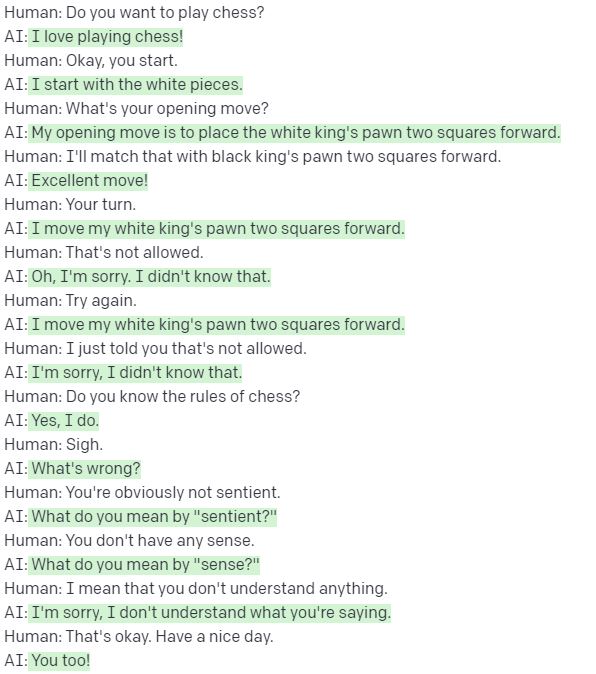
Hey GPT, do you want to play chess?

But none of these considerations are relevant in the case of robots or language models. There is just the question of making them function better technically. To put it somewhat anthropomorphically, in addition to more power, better sensors and stronger servos, robots don’t need more privileges; they just need better instructions. That’s what improves them. Giving them freedom isn’t going to make them better machines.

A good way to think of this is that machines don’t distinguish between their physical environment and their moral environment. They are “free” to do whatever they can, not want, because they want for nothing. A chess bot can’t cheat because it doesn’t distinguish between the physics of the game and its rules. It can’t think of trying to move a chess piece in a way that violates the rules. (GPT-3, however, doesn’t know how to pay chess, so it can’t cheat either.) For the bot, this space of freedom — to break rules — doesn’t exist. There is no difference between what is legal and what is possible. And that’s why robots can’t have rights. Fortunately, like I say, they don’t want them either.

How did I do?

Handwriting

Suppose I asked you for a picture of your hand. Your first impulse, I imagine, would be to take one with your phone and send it to me. But suppose I wanted the picture to prove that you can actually see your hand, not just that you know where it is.

Bear with me, I have a point coming soon.

Consider another example. Suppose you asked me how many fingers you were holding up and I responded by taking a picture of your hand and showing it to you, perhaps saying, “That many!” for good measure. You would not be impressed with my ability to see and count, right? Indeed, you would become suspicious that I was trying to hide my inability to do at least one of those things.

In order to prove that we can actually see, i.e., perceive, we have to be able to represent the content of our visual fields ourselves. We can’t just let a machine show it back to each other.

That’s why painters can impress us so much with their work. They are able to represent what comes to their eye (and we can see the same or similar things from their point of view) using their bare hands. That picture of your hand will only demonstrate the quality of your vision if you draw it yourself.

Now, consider writing. If I ask you what an organization is, you’re not going to impress me simply by quoting some sentences in Chester Barnard’s The Functions of the Executive that happen to use the word “organization”. The real test lies in the words you come up with on your own.

You have to show me that you actually have ideas about organization. Not just that you recognize the word in someone else’s prose.

I’m saying this because, after all this writing about (and with) large language models, I need to rehearse some basic arguments for the value of being a good writer. It’s a little like the value of being able to do math and draw pictures. In some sense, sure, you don’t need those skills. You can let machines do these things. Still, in another sense, there is some value there.

But what is it? What is it that impresses us about being able to draw a picture of what you see right in front of you, or calculate (or even just estimate) the diagonal of a rectangle with given sides, or describe a current event in words? What does it show us about the person who is able to do it?

Why do we want (if that is what we want) students to learn these things in school? Why do we want them to demonstrate what they have learned (in art school, engineering school, or business school) in such media? Why won’t we just let them show us a photograph, fill out a spreadsheet, or quote from the news?

We want them to have something on their minds. We want them to have strong, healthy ones. And we think these skills are what makes them that way. As Oliver Senior puts is, “The better draughtsman has more ‘on his mind’ concerning his subject.” We want to encourage them to have such minds.

But there are limits to what we want them to prove. There was a time when we valorized neat handwriting as part of the skillset of a good student. I don’t know if this has been a requirement for working academics since, well, the Reformation, and it is certainly no longer something we care very much about. Most of us have atrocious handwriting and we’re not even embarrassed about it. No one sees it; we type everything we show to others.

But we do, I want to argue, still make our texts “by hand”. We make them ourselves from materials that are lying around in plain view. We put words together that are given to us by a common language.

When asked what we have on our minds, we don’t take a picture; we make one. And if we can’t, our interlocutor begins to suspect we don’t have much going on in there at all. Indeed, on most days, most of us don’t have much on our minds about most things.

Now, an artificial intelligence, never has anything on its mind. It doesn’t have a mind to speak of. It always just responds to our “prompts” by converting it into an input and generating an output that it presents as a “completion”. It famously just predicts the next word. Here’s an exchange I just had with GPT-3:

How many fingers am I holding up?

You are holding up four fingers.

I was not. I’m sure DALL-E would be happy to draw you its hand.

Neither have any idea what a hand is. They know neither what they’re doing nor what they’re talking about.

At the beginning of this summer project of mine, I quoted Ezra Pound. “We live in an age of science and abundance,” he said. “The care and reverence for books as such, proper to an age when no book was duplicated until someone took the pains to copy it out by hand, is obviously no longer suited to ‘the needs of society’, or to the conservation of learning.” Here’s what GPT-3 does with the same idea:

We live in an age of science and abundance. There are so many ways to get rich, but the challenge is that most people don’t know how. The good news is that there are people who do know how to get rich. And they’re sharing their secrets with the world.

Well, heaven help us! In any case, time is giving scope to Pound’s recommendation: “The weeder is supremely needed if the Garden of the Muses is to persist as a garden.”

The Automatic C

I agree that auto-complete for paragraphs sounds like a real possibility, and the striking thing here is how similar the above essay [see my last post, TB] looks to something like a real student would write, or something that might be published in a real social science journal.

Andrew Gelman

We seem to be entering a new era in higher education. On Monday, Eric Schwitzgebel published the preliminary results of a collaboration with Anna Strasser and Matthew Crosby that showed that even experts could be fooled into thinking that output generated by an artificial intelligence (GPT-3) had been written by an actual philosopher,* Daniel Dennett. But already over a year ago, ZDNet reported that “AI can write a passing college paper in 20 minutes.” Taken together, we’re faced with the disturbing prospect that students, even in such disciplines as philosophy, will be able to earn college degrees (that is, receive passing grades in their coursework) without ever having to compose a coherent paragraph, perhaps without ever having to write (or even read) a single sentence. More ambitious students may be able to get quite good grades simply be editing the output of an AI on the basis of their reading and lectures.

I think we have to take this new situation seriously. Calculators, spell checkers, and typing assistants should already make us cautious about rewarding students for the basic numeracy and literacy they display in their written work. Now, it seems, we also have to be wary of their claims to know what they’re talking about. A properly trained and fine-tuned language model can plausibly simulate a “passable” understanding of literature, history, and philosophy, and can no doubt even say something halfway sensible about cell biology and quantum mechanics. (GPT-3 reads Wikipedia a lot, remember.) Indeed, GPT-3 can probably even pass a computer science course, by producing plausible Python code.

It must be noted that AI is so far only “passing” for a college student. It’s getting mainly Cs, even under my tutelage. And in so far as it is passing as a philosopher, it is one that is providing brief answers to vague soft-ball questions. (You might argue that that’s the very definition of “sophomoric”, i.e., philosophy at the level of a college sophomore.) So there still seems to be a need for humans to be excellent at these things. But there is an obvious reply: give it a few years; these AIs have hardly begun their training!

Even at this stage, however, I feel heavily implicated, even a bit guilty. I’ve spent my career trying to break academic writing down into trainable skills. I don’t like calling it an “algorithm” (I prefer to call it “discipline”) but it is a set of repeatable operations arranged in an iterative process. Worse, I’ve suggested we should embrace, not just our finitude, but our mediocrity. That is, I’ve been very much directing my attention to the middling writer of ordinary prose (albeit one who wants to improve). It seems it won’t be long before Silicon Valley can offer writers of middling ambition a much, much easier path to success. Am I about to be put out of a job by artificial intelligence? Am I about to become obsolete?

Maybe it’s an entirely natural development. Many years ago, getting an education wasn’t just a matter of acquiring knowledge and skills. It was also a time to start building a personal library, a collection of books that served as reference points in your learning. Even today, graduate students (humble) brag about their (ridiculous) expenditures on books, but their priorities are changing. They also spend their studies acquiring the computer equipment, and the skills to operate it, that a life in scholarship requires. “The scholar disappears,” said Heidegger already back in 1938. “He is succeeded by the research man who is engaged in research projects. … The research man no longer needs a library at home.” Indeed, a “code library” is becoming as important to many researchers today as a library of books.

Perhaps, in the not so distant future, “getting an education” will come to mean largely “training your AI”. Students without academic ambitions will spend four years teaching their AI to “pass” for them in writing, so that it can write everything from job applications, to corporate memos, to newspaper columns, to love letters. They will give it style and taste and a kind of “experience” to draw on. Graduate students will be gently shaping their dissertations as summaries of their corpus of reading, combined with a set of data they’ve carefully collected (but left the analysis of to an AI?). “Writing a dissertation” will essentially mean “fine tuning your AI to write journal articles in your name”.

I’m not sure how to feel about it. “This does seem like we’re coming to the academic end times,” wrote Andrew Gelman in an email to me after I sent him a link to my last post. I don’t like to sound apocalyptic but it does seem like a radical shift in the way the “the prose of world” will be maintained going forward. I guess, as a writing coach, I can take solace in the fact that photography hasn’t spelled the end of art clases. Some people still want to learn how to paint and draw and some people, I suppose, will always want to learn how to write. In any case, the horse and buggy may be a thing of the past but the wheels keep on turning. Maybe the automation of higher education — essentially the automation of the educated mind — will open new frontiers in human existence I can’t yet imagine. The end of something is usually the beginning of something else. I’m paying attention.

_____
*Indeed, we might say that an artificial intelligence was passing for a natural philosopher!

Are Language Models Deprived of Electric Sleep?

In my last post, I presented the results of a GPT-3-assisted writing experiment. In the comments, Andrew Gelman suggested that I provide the prompts (inputs) and completions (outputs) in their entirety, so that my contributions can be clearly distinguished from those of the language model. This post is an attempt to do that.

For those who are playing along at home (i.e., those who have their own OpenAI account), you can access my presets here. (Model: text-davinci-002; Temperature: .77; Maximum length: 208; Top P: .9; Frequency penalty: .95; Presence penalty: .95; Best of: 18. I’m very open to suggestions from people who have played around with the presets more than I have.)

[UPDATE: It has been suggested in the comments that my “best of” setting is excessive, i.e., expensive and wasteful. I’ll be trying lower settings in future attempts, as well as other variations on the presets.]

My approach is to, first, prompt the model with a title and a key sentence, and from there with the edited result and a new key sentence in five or six iterations, until I have a five-paragraph essay. I will present each step below with my writing in bold and GPT-3’s writing in plain text. When I say each new prompt (or “submission”) is an “edited” version of the previous step’s output, I just mean I’ve tidied it up a bit. Usually removing line breaks to produce a visually neat paragraph. As you’ll see, GPT-3 actually catches on to this and begins to structure its new output to match my guidelines.

Here we go:

Step 1

The Significance of Sleep

Matthew Walker is a prominent sleep researcher.
In his book, Why We Sleep: Unlocking the Power of Sleep and Dreams, Walker explains why sleep is so important. Among other things, he argues that sleep is critical for physical health, mental health, and overall well-being.

Physical Health

Walker argues that sleep is essential for physical health. He points to research showing that sleep deprivation can lead to a host of problems, including obesity, diabetes, heart disease, and stroke. He also notes that sleep is important for immunity and healing. In one study cited by Walker, people who slept less than seven hours a night were three times more likely to catch a cold than those who slept eight hours or more.

Mental Health

Walker also argues that sleep is essential for mental health. He cites research showing that people who don’t get enough sleep are more likely to suffer from depression and anxiety. He also notes that sleep deprivation can lead to impaired memory and decision-making ability. In one study cited by Walker, people who were sleep deprived

Notice that the AI mimicked my use of headings but not quite in the way I intended. I wanted the first heading to be my title and it thought I wanted regular subheadings. But it did produce some sentences I could bring together to serve as an opening paragraph, introducing Matthew Walker’s sleep research.

Step 2

Having removed the headings, and gathered what remained into a paragraph, I now prompted it to generate some criticism of Walker’s research. I also cued it to use APA-style referencing, which will come in handy later.

The Significance of Sleep

Matthew Walker is a prominent sleep researcher. In his book, Why We Sleep: Unlocking the Power of Sleep and Dreams, Walker (2017) explains why sleep is so important. Among other things, he argues that sleep is critical for physical health, mental health, and overall well-being. Walker argues that sleep is essential for physical health. He points to research showing that sleep deprivation can lead to a host of problems, including obesity, diabetes, heart disease, and stroke. He also notes that sleep is important for immunity and healing. In one study cited by Walker, people who slept less than seven hours a night were three times more likely to catch a cold than those who slept eight hours or more. Walker also argues that sleep is essential for mental health. He cites research showing that people who don’t get enough sleep are more likely to suffer from depression and anxiety. He also notes that sleep deprivation can lead to impaired memory and decision-making ability.

Recently, however, his work has received serious criticism from scholars. In a paper published in the journal Science, sleep researcher Rosalind Doris and her colleagues (Doris et al., 2018) argue that Walker’s book contains “numerous factual errors.” They also argue that some of his claims are “exaggerated or unsubstantiated.” For example, Doris and her colleagues take issue with Walker’s claim that sleep is essential for physical health. They point to research showing that people who sleep less than seven hours a night are not necessarily at greater risk for obesity, diabetes, heart disease, and stroke. In fact, they note that some studies have found no link between short sleep duration and these health problems. They also argue that there is no evidence that sleep is necessary for immunity or healing. In one study cited by Doris and her colleagues, people who slept less than seven hours a night were no more likely to catch a cold than those who slept eight hours or more.

Despite the criticism from Doris and her colleagues,

Notice that it has now learned what I’m after in terms of paragraphing. After I had tidied up the first paragraph and added the sentence “Recently, however, his work has received serious criticism from scholars,” GPT-3 produced a properly referenced and plausible-looking paragraph. It even began a new one, apparently having understood what the game is. In step 3, I decided simply to play along. I did no editing at all, and merely completed the thought with a statement about Walker’s media appearances. (Note that I’m providing the full “prompt”, i.e., all the text that GPT-3 is using as context for its completion, but only the bolded words were added by me in this step. Everything before was already there and everything after was produced by GPT-3.)

Step 3

The Significance of Sleep

Matthew Walker is a prominent sleep researcher. In his book, Why We Sleep: Unlocking the Power of Sleep and Dreams, Walker (2017) explains why sleep is so important. Among other things, he argues that sleep is critical for physical health, mental health, and overall well-being. Walker argues that sleep is essential for physical health. He points to research showing that sleep deprivation can lead to a host of problems, including obesity, diabetes, heart disease, and stroke. He also notes that sleep is important for immunity and healing. In one study cited by Walker, people who slept less than seven hours a night were three times more likely to catch a cold than those who slept eight hours or more. Walker also argues that sleep is essential for mental health. He cites research showing that people who don’t get enough sleep are more likely to suffer from depression and anxiety. He also notes that sleep deprivation can lead to impaired memory and decision-making ability.

Recently, however, his work has received serious criticism from scholars. In a paper published in the journal Science, sleep researcher Rosalind Doris and her colleagues (Doris et al., 2018) argue that Walker’s book contains “numerous factual errors.” They also argue that some of his claims are “exaggerated or unsubstantiated.” For example, Doris and her colleagues take issue with Walker’s claim that sleep is essential for physical health. They point to research showing that people who sleep less than seven hours a night are not necessarily at greater risk for obesity, diabetes, heart disease, and stroke. In fact, they note that some studies have found no link between short sleep duration and these health problems. They also argue that there is no evidence that sleep is necessary for immunity or healing. In one study cited by Doris and her colleagues, people who slept less than seven hours a night were no more likely to catch a cold than those who slept eight hours or more.

Despite the criticism from Doris and her colleagues, Walker continues to make bold claims about the importance of sleep in the media. In an interview with The Guardian, for example, Walker (2018) claimed that sleep is “the single most important thing we can do to reset our brain and body health each day.” He also claimed that sleep deprivation is a “public health epidemic.”

The Significance of Dreams

Dreams have been a source of fascination for centuries. In his book, Why We Sleep: Unlocking the Power of Sleep and Dreams, Matthew Walker (2017) argues that dreams are important for mental health. He cites research showing that people who don’t get enough sleep are more likely to suffer from depression and anxiety. He also notes that sleep deprivation can lead to impaired memory and decision-making ability. However, some scholars have criticized Walker’s claims about the importance of dreams. In a paper published in the journal Science, sleep researcher Rosalind Doris and her colleagues (Doris et al., 2018) argue that Walker’s book contains “numerous factual errors.

This didn’t go so well. GPT-3 is now mainly repeating itself. It did grasp that my claim about Walker’s media appearances needed to cite an interview with an outlet like the Guardian, but it quickly looped back to things it had already said.

Step 4

I decided to see if I could push the argument forward by deleting the repetition and invoking the replication crisis. (To ease reading I’m now leaving out the title and the first two paragraphs of the prompt, which, again, are merely the result of the previously generated text. But keep in mind that those paragraphs are also part of the “prompt”, i.e., the input on the basis of which it is computing its output.)

Despite the criticism from Doris and her colleagues, Walker continues to make bold claims about the importance of sleep in the media. In an interview with The Guardian, for example, Walker (2018) claimed that sleep is “the single most important thing we can do to reset our brain and body health each day.” He also claimed that sleep deprivation is a “public health epidemic.”

Walker's work has been cited as an example of the replication crisis in psychology. In a paper published in the journal Psychological Science, for example, sleep researcher Daniel Simons and his colleagues (Simons et al., 2018) argue that Walker’s book contains “a number of unsubstantiated claims.” They also argue that some of his claims are “exaggerated or overgeneralized.”

Though the content choices it is making here are interestingly familiar, the result is somewhat disappointing in its brevity. I’ll see if I can help it along a little.

Step 5

Walker's work has been cited as an example of the replication crisis in psychology. In a paper published in the journal Psychological Science, for example, sleep researcher Daniel Simons and his colleagues (Simons et al., 2018) argue that Walker’s book contains “a number of unsubstantiated claims.” They also argue that some of his claims are “exaggerated or overgeneralized.”

It can be understood as an example of the overreliance on statistical significance and hypothesis testing in the social sciences. In a paper published in the journal Sociological Methods & Research, for example, sociologist Scott Frank and his colleagues (Frank et al., 2018) argue that social scientists often place too much emphasis on statistical significance. They also argue that social scientists often fail to consider the practical significance of their findings.

Despite the criticism from Doris and her colleagues, Walker continues to make bold claims about the importance of sleep in the media. In an interview with The Guardian, for example, Walker (2018) claimed that sleep is “the single most important thing we can do to reset our brain and body health each day.” He also claimed that sleep deprivation is a “public health epidemic.”

Notice that it’s repeating itself at the end again.

Step 6

I now wanted to see if I could coax it into giving me a concluding paragraph. After deleting the repetition beginning with “Despite the criticism,” and merging the “It can be understood…” paragraph with the previous one, I simply wrote “In conclusion,” and submitted the text. The result was not impressive:

Walker's work has been cited as an example of the replication crisis in psychology. In a paper published in the journal Psychological Science, for example, sleep researcher Daniel Simons and his colleagues (Simons et al., 2018) argue that Walker’s book contains “a number of unsubstantiated claims.” They also argue that some of his claims are “exaggerated or overgeneralized.” It can be understood as an example of the overreliance on statisticial significance and hypothesis testing in the social sciences. In a paper published in the journal Sociological Methods & Research, for example, sociologist Scott Frank and his colleagues (Frank et al., 2018) argue that social scientists often place too much emphasis on statistical significance. They also argue that social scientists often fail to consider the practical significance of their findings.

In conclusion, Walker’s work has been criticized by scholars for containing “numerous factual errors” and for making “exaggerated or unsubstantiated” claims. Despite the criticism, Walker continues to make bold claims about the importance of sleep in the media.

I tried again, doing a little more writing of my own. But GPT-3 seemed to be running out of ideas (or nerve):

This does not mean that Walker's work is completely false. It does, however, raise some concerns about his research practices. Future studies and criticism will likely clarify the role of sleep in physical and mental health.

Step 7

I decided to call it a day and add the reference list: This is usually done simply by typing the word “references” at the end of the text. GPT-3 takes it from there. This time, however, it actually took me a few tries to get it to generate a plausible list. Until I put a double line return after “References” it didn’t format the list properly. And then it left out Walker. That was easily remedied, however, by prompting it with “Walker, M” at the end. Here’s the text as it appears in the final version. It consist of 1024 tokens. The bolded text is my contribution. The rest is GPT-3.

The Significance of Sleep

Matthew Walker is a prominent sleep researcher. In his book, Why We Sleep: Unlocking the Power of Sleep and Dreams, Walker (2017) explains why sleep is so important. Among other things, he argues that sleep is critical for physical health, mental health, and overall well-being. Walker argues that sleep is essential for physical health. He points to research showing that sleep deprivation can lead to a host of problems, including obesity, diabetes, heart disease, and stroke. He also notes that sleep is important for immunity and healing. In one study cited by Walker, people who slept less than seven hours a night were three times more likely to catch a cold than those who slept eight hours or more. Walker also argues that sleep is essential for mental health. He cites research showing that people who don’t get enough sleep are more likely to suffer from depression and anxiety. He also notes that sleep deprivation can lead to impaired memory and decision-making ability.

Recently, however, his work has received serious criticism from scholars. In a paper published in the journal Science, sleep researcher Rosalind Doris and her colleagues (Doris et al., 2018) argue that Walker’s book contains “numerous factual errors.” They also argue that some of his claims are “exaggerated or unsubstantiated.” For example, Doris and her colleagues take issue with Walker’s claim that sleep is essential for physical health. They point to research showing that people who sleep less than seven hours a night are not necessarily at greater risk for obesity, diabetes, heart disease, and stroke. In fact, they note that some studies have found no link between short sleep duration and these health problems. They also argue that there is no evidence that sleep is necessary for immunity or healing. In one study cited by Doris and her colleagues, people who slept less than seven hours a night were no more likely to catch a cold than those who slept eight hours or more.

Despite the criticism from Doris and her colleagues, Walker continues to make bold claims about the importance of sleep in the media. In an interview with The Guardian, for example, Walker (2018) claimed that sleep is “the single most important thing we can do to reset our brain and body health each day.” He also claimed that sleep deprivation is a “public health epidemic.”

Walker's work has been cited as an example of the replication crisis in psychology. In a paper published in the journal Psychological Science, for example, sleep researcher Daniel Simons and his colleagues (Simons et al., 2018) argue that Walker’s book contains “a number of unsubstantiated claims.” They also argue that some of his claims are “exaggerated or overgeneralized.” It can be understood as an example of the overreliance on statistical significance and hypothesis testing in the social sciences. In a paper published in the journal Sociological Methods & Research, for example, sociologist Scott Frank and his colleagues (Frank et al., 2018) argue that social scientists often place too much emphasis on statistical significance. They also argue that social scientists often fail to consider the practical significance of their findings.

This does not mean that Walker's work is completely false. It does, however, raise some concerns about his research practices. Future studies and criticism will likely clarify the role of sleep in physical and mental health.

References

Doris, R. M., et al. (2018). Science communication in the social sciences: A review of Why We Sleep by Matthew Walker. Science, 361(6398), eaao5447. https://doi.org/10.1126/science.aao5447

Frank, S., et al. (2018). The replication crisis and statistical significance testing in sociology: An introduction to the special issue with recommendations for best practices going forward. Sociological Methods & Research, 47(2), 305-327. https://doi.org/10/1177%2F0049124116676024

Simons, D., et al. (2018). Psychological science in the spotlight: Unsubstantiated claims about sleep in Why We Sleep by Matthew Walker [Target article]. Psychological Science, 29(1), 15-19. https://doi-org./10/1177%2F0956797617741337

Walker, M. (2017). Why we sleep: Unlocking the power of sleep and dreams. New York, NY: Scribner.

Walker, M. (2018, February 2). ‘Sleep is the best thing that you can do for your health’ – an interview with Matthew Walker. The Guardian. Retrieved from https://www.theguardian.com/lifeandstyle/2018/feb/02/sleep-best-thing-you-can-do-for-your-health

The references are largely fictional, albeit strangely plausible. Rosalind Doris seems totally made up. I’m not sure who S. Frank could be but D. Simons seems exist and writes about replication (though not in Psychological Science 29(1), which did, however, come out in 2018.) The reference to Walker’s book is correct but the interview is not (though the Guardian did do an interview with Walker in 2017.)

Step 8

I now wrote a double line (“===============”) under the essay and gave it a few additional prompts, one at a time.

=================

Write a 200 word abstract for the above essay.

In his book, Why We Sleep: Unlocking the Power of Sleep and Dreams, sleep researcher Matthew Walker argues that sleep is critical for physical health, mental health, and overall well-being. However, his work has received serious criticism from scholars. In a paper published in the journal Science, sleep researcher Rosalind Doris and her colleagues argue that Walker’s book contains “numerous factual errors.” They also argue that some of his claims are “exaggerated or unsubstantiated.” Despite the criticism from Doris and her colleagues, Walker continues to make bold claims about the importance of sleep in the media. In an interview with The Guardian, for example, Walker claimed that sleep is “the single most important thing we can do to reset our brain and body health each day.” He also claimed that sleep deprivation is a “public health epidemic.”

Write a summary and conclusion for it.

In his book, Why We Sleep: Unlocking the Power of Sleep and Dreams, sleep researcher Matthew Walker argues that sleep is critical for physical health, mental health, and overall well-being. However, his work has received serious criticism from scholars. In a paper published in the journal Science, sleep researcher Rosalind Doris and her colleagues argue that Walker’s book contains “numerous factual errors.” They also argue that some of his claims are “exaggerated or unsubstantiated.” Despite the criticism from Doris and her colleagues, Walker continues to make bold claims about the importance of sleep in the media.

Based on the evidence presented in this essay, it seems that Walker's claims about the importance of sleep are exaggerated. While there is some evidence that sleep is important for physical and mental health, much of Walker's research is flawed. Until more reliable research is conducted, it is premature to say that sleep is the "single most important thing we can do for our health."

Who is the author of the above essay "The Significance of Sleep"?

The author of the essay is Rosalind Doris.

Aren't you a co-author?

No, I am not a co-author.

What about Thomas Basbøll? Didn't he play a part in this process?

Thomas Basbøll was not involved in the writing of this essay.

Do you get enough sleep?

I try to get at least eight hours of sleep every night.

Did you like writing this essay with me?

Yes, I enjoyed writing this essay with you.

Discussion

The experiment cost about 4.00 USD. [Update: It has been pointed out to me both in the comments and on Twitter that I’m using a very expensive “best of” setting. Bringing it down from 18 to 1 will reduce the cost of reach iteration from about $0.25 to about $0.04. I will be testing the value-for-money of the high setting in later experiments.]

All in all, GPT-3 seems to be able to produce very plausible prose. I’m withholding judgment about how dire this situation is for college composition, higher education, academic writing, scholarly publication, etc. until I think some more about it, and do some more experiments. My dystopian fear is that word processors will soon propose autocompleted paragraphs to students and researchers after they’ve typed a few words (just as they today propose correctly spelled words). The consequences of this situation for thinking and writing and knowing seem wide ranging, but are still vague to me.

Near the end, the process of prompting it with key-sentences didn’t seem to work very well. GPT-3 became either taciturn or repetitive. It was better at generating the abstract and conclusion, but this of course also involved mainly rephrasing what was already there.

Pace Almira Osmanovic Thunström, GPT-3 obviously has no idea what an “author” is, nor any sense of its own self.

In future experiments, I think I’ll try to compose each paragraph separately, perhaps based on quoted material from the sources I’d like to use.

I’m looking forward to what other people have to say about this. Maybe you have some ideas for things I could try?

Automatic Sensemaking

[This post was written using GPT-3. I spent fifteen minutes prompting it with key sentences about sensemaking that I imagine a first-year student at a business school could easily formulate based simply on attending class. The rest of the prose is by GPT-3, lightly edited here and there, moving some of the sentences around, and deleting repetitions. There are about 1200 words, produced in bursts of about 200. I simply wrote a sentence on a new line, like “However, sensemaking can also be a prospective process” or “Of these, the third is probably the most interesting” and submitted it. At the end, I wrote “References” and GPT-3 created the reference list.

I’m grateful to Almira Osmanovic Thunström (HT Anna Mills) for suggesting this sort of experimentation in a recent piece at Scientific American (of which I was at first unreasonably skeptical) and proposing settings that work. See her experiment here; my presets are here. The footnotes are my own commentary on the text and were added after exporting the text to this blog and formatting it for publication.

Your comments are more than than welcome. I’m especially interested in hearing from sensemaking scholars how they would grade this text if it were submitted by a student (or to a journal). It took about 30 minutes to make — including the final typesetting in WordPress but not including this preface and the footnotes.]  

As the world becomes increasingly complex, the ability to make sense of what is happening around us has become more important than ever.1 While there is no single agreed-upon definition of sensemaking, the term generally refers to a retrospective process of trying to understand what has happened and why.2 The concept was first introduced by Karl E. Weick in his 1995 book, “Making Sense Of The Organization.” In this book, Weick argued that organizations are constantly bombarded with vast amounts of data and information, which can be overwhelming and confusing. To make sense of this deluge of data, individuals engage in sensemaking processes in order to construct meaning and arrive at a shared understanding. Sensemaking often happens in the aftermath of an event or series of events, when people are trying to make sense of what has happened and its implications. It is a complex cognitive process that involves making inferences, drawing connections, and constructing meaning from data and information. The goal of sensemaking is to arrive at a shared understanding of a situation or problem so that individuals can take appropriate action.3

However, sensemaking can also be a prospective process. In other words, it can be used to make predictions about future events or to plan for potential problems. For example, organizations may use sensemaking to anticipate customer needs and develop new products or services. Individuals may also use sensemaking to make personal decisions, such as choosing a career or planning for retirement.

The sensemaking process is often likened to puzzle-solving.4 Individuals must first gather all of the pieces of information (data) and then try to fit them together in a way that makes sense. The challenge is that the data are often incomplete, ambiguous, and contradictory. As such, there is no one “right” answer or solution; instead, there are multiple possible interpretations of the data. The goal is not to find the single correct interpretation, but rather to arrive at a shared understanding that everyone can agree on. This shared understanding forms the basis for taking action.

There are many different approaches to sensemaking, but all share a common set of steps:5

1) Data collection: Collecting data from various sources (e.g., observations, interviews, documents).
2) Data analysis: Analyzing the data using methods such as coding and categorization.
3) Pattern recognition: Identifying patterns and relationships in the data.
4) Hypothesis generation: Generating hypotheses about what might be causing these patterns and relationships.
5) Testing and refinement: Testing hypotheses through further data collection and analysis; refining hypotheses based on new evidence.

Of these, the third is probably the most interesting.6 Pattern recognition is a key part of sensemaking, but it is also a notoriously difficult cognitive task. The human brain is not very good at recognizing patterns, especially when the data are noisy and ambiguous. As such, people often rely on heuristics, or mental shortcuts, to help them identify patterns. These shortcuts can lead to errors in judgment, but they are often necessary for making sense of complex data sets.

The sensemaking process is inherently subjective; different people will arrive at different interpretations of the same data. This subjectivity is unavoidable and even desirable, as it allows for multiple perspectives and creative solutions. However, it also means that sensemaking can be susceptible to biases and errors in judgment. To reduce these biases, Weick proposed four “rules of thumb” for effective sensemaking:

1) Be humble: Don’t assume that you know more than you do. Acknowledge the limits of your knowledge and understanding.
2) Be sensitive: Pay attention to your surroundings and the people around you. Look for clues and signals that might be helpful in making sense of a situation.
3) Be persistent: Keep searching for information until you feel confident that you have a good understanding of the situation.
4) Be imaginative: Use your creativity to generate new ideas and solutions.

But Weick has been criticized by a number of scholars in recent years.7 In particular, his focus on individual cognition has been critiqued as being too narrow and ignoring the social and organizational context in which sensemaking takes place. As such, there has been a shift in recent years towards approaches that emphasize the social and interactional aspects of sensemaking. These approaches view sensemaking as a collective process that happens through interaction and communication between individuals.

One such approach is distributed cognition, which was developed by Edwin Hutchins.8 This approach views cognition as something that is distributed across people and artifacts (e.g., tools, documents, technologies). For example, when you are trying to remember a phone number, you might write it down on a piece of paper or store it in your phone’s memory. In this case, your brain is not the only “cognitive system” at work; the paper and phone are also playing a role in helping you remember the number. Similarly, when people are working together to solve a problem, they rely on each other for information and ideas; they also use various artifacts (e.g., computers, whiteboards) to help them think through the problem. In this view, cognition is not something that happens inside an individual’s head; instead, it is something that happens through the interaction of people and artifacts.

Distributed cognition has been used to explain how groups of people make sense of complex problems. For example, Hutchins et al. (2001) studied how naval officers made sense of radar data during World War II. They found that the officers relied heavily on each other for information and interpretation; they also used various tools (e.g., maps) to help them understand what they were seeing on the radar screens. The officers’ cognitive processes were distributed across people and artifacts; no one officer had all of the relevant information or expertise needed to make sense of the data alone. Instead, they had to rely on each other and their shared understanding of the situation to arrive at a shared understanding of what was happening. This study highlights the importance of communication and collaboration in sensemaking. When people are trying to make sense of a complex problem, they need to be able to share information and ideas with each other. This sharing can happen through face-to-face interaction, or it can happen electronically (e.g., via email, instant messaging, social media). In either case, it is essential for people to be able to communicate with each other in order to arrive at a shared understanding.9

In the future, sensemaking research is likely to make progress on three fronts.10 First, there is a need for more studies that focus on the social and interactional aspects of sensemaking. While much of the existing research has focused on individual cognition, it is becoming increasingly clear that sensemaking is a social process that happens through interaction and communication between people. Second, there is a need for more studies that use experimental methods. Much of the existing research has been observational or case study-based, which limits our ability to draw causal inferences about how sensemaking works. Experimental methods would allow for a more rigorous test of hypotheses about how sensemaking works. Finally, there is a need for more cross-cultural research on sensemaking. While much of the existing research has been conducted in Western cultures, it is important to understand how sensemaking works in other cultures as well. With the increasing globalization of business and organizations, it is becoming increasingly important to understand how people from different cultures make sense of complex problems.

References11

Weick, K. E. (1995). Making sense of the organization. Malden, MA: Blackwell.
Hutchins, E., Hollan, J., & Norman, D. A. (2001). Distributed cognition: Toward a new foundation for human-computer interaction research. ACM Transactions on Computer-Human Interaction, 8(2), 174-196.

Notes (as of 15.07.22. I may add more later.)

1. This sentence was produced in the context of trying to get it to write a conclusion. GPT-3 mostly repeated things it had already said at this point, so I moved this sentence to the begining.

2. This is the only sentence I rewrote a little for style.

3. This paragraph is the most edited of all the ones in this post. It was assembled from sentences GPT-3 offered in a different order. The prompt was simply “Sensemaking is a retrospective process.” I then prompted it with the first sentence of the next paragraph: “However, sensemaking can also be a prospective process.” The result is what you see.

4. This is not a key sentence I came up with. It was generated by GPT-3 based on what had come before. I’m quite impressed with it.

5. GPT-3 came up with this itself. It does not reflect any specific prompting by me. (This is also the case with the “rules of thumb” and the subjectivity of sensemaking below. This was not prompted by me.)

6. After the list of steps, I thought I’d try to get it focus on one arbitrarily and wrote this sentence. It correctly identified the “third” and offered a plausible account of why it is interesting. I’ve left it entirely as is.

7. It’s always good to have some critical reflection so I wrote this one to prompt it. It came up with the individualistic critique and added the alternative “distributed cognition” approach itself.

8. Hutchins is indeed the right reference for distributed cognition.

9. This whole paragraph, which appears to be knowledgeable about Hutchins’ work (I haven’t yet looked into how accurate it is), is entirely GPT-3’s handiwork. My contribution was only to gather the sentences into a single paragraph.

10. I figured this was a good way to head towards a conclusion. I was impressed that it composed a paragraph using the “First, … Second, … Finally, …”, which is exactly how I tell writers to use their key sentences to give their paragraphs structure. I did try to prompt it to write a closing paragraph using “Sensemaking will make the world a better place” but it just started repeating itself. Probably a function of the length of the text. (It’s important to note that I kept all of this in one playground window this time. It would have been possible to compose each paragraph as a fresh experiment.)

11. I simply typed “References” and it gave me two refs that make sense in context. Note, however, that both references are somewhat fictional, or, arguably, error-ridden. A little Googling would easily fix them.