Category Archives: Uncategorized

The Advertiser’s Stance

This perversion is probably in the long run a more serious threat in our society than the danger of ignoring the audience.

Wayne C. Booth, “The Rhetorical Stance,” CCC, 14(3), 1963.

Academics today are strongly encouraged ensure the “impact” of their research. They are told to measure their success, at least in part, by the effect they have on the public and the policy makers who represent it. For my part, I’ve long tried to push against this eagerness to “really matter”; I have, for example, urged academics to curb their romance with storytelling and focus on their peers and students. I think there is perfectly respectable work to be done entirely within the ivory tower and, like Wayne Booth, I fear that the desire for broader impact establishes some “perverse” incentives for scholars.

Booth tells the story of a dinner party where he was told that his book’s title (which included the word “rhetoric”) was not sufficiently gripping. He’d have been better off polling a few hundred “businessmen” and then settle on a title that would sell, said his tablemate, who happened to be an advertising consultant. Indeed, whether the title “fit the book” was not as important as we might think. “If the book is designed right, so that the first chapter pulls them in, and you keep them in, who’s going to gripe about a little inaccuracy in the title?”

When I read this I was reminded of exchange I had with Patrick Dunleavy. When he announced the publication of Maximizing the Impacts of Academic Research, I suggested that, given the “replication crisis”, perhaps we should also talk about minimizing the harms of academic research. That is, there sometimes seems to be an assumption among promoters of the “impact agenda” that all scientific results are true and their impact can therefore only be good. Maximizing the impact of research results means maximizing their spread in society, which means maximizing these positive effects. But that assumption doesn’t seem to hold. If half of all research results are wrong, maximing their impact doesn’t sound like such a great idea any longer. Perhaps we should talk of “optimizing,” I suggested.

Patrick and I agree on a lot of things, and this turned out to be one of them. In fact, he wanted to call the book Improving the Impact of Academic Research but his publisher insisted on Maximizing. They are no doubt right to assume that the book has been designed right and that no one is going to gripe too much about the title. In fact, while I suppose I did gripe, it was only a little and, as Booth’s advertising consultant predicted, I was immediately placated by the book’s more balanced content.

Nonetheless, by its mere existence, the book gives weight (not balance) to the slogan “Maximize Your Impact!” and that does leave me somewhat uneasy. Back in 1963, Booth put it as follows:

In the time of audience-reaction meters and pre-tested plays and novels, it is not easy to convince students of
the old Platonic truth that good persuasion is honest persuasion, or even of the old Aristotelian truth that the good rhetorician must be master of his subject, no matter how dishonest he may decide ultimately to be. Having told them that good writers always to some degree accommodate their arguments to the audience, it is hard to explain the difference between justified accommodation — say changing point one to the final position — and the kind of accommodation that fills our popular magazines, in which the very substance of what is said is accommodated to some preconception of what will sell.

The technology has changed since then — we’re more likely to speak of “metrics” and “focus groups” (not to mention “sensitivity readers”!) — but the problem is the same. There is an incentive to “accommodate” pressures that are entirely extrinsic to the author’s primary purpose. Booth rightly points out that it is difficult to convince students to stand firm against these pressures, developing and defending opinions of their own. “The advertiser’s stance,” he tells us, “comes from undervaluing the subject and overvaluing pure effect.” Of course, his students have long since graduated, some of them have become scholars, and many have probably even retired. Today, these extrinsic pressures have become altogether intrisic to the life of academics. It’s hard to find your balance when the “pure effect” of not publishing, of not having an “impact”, is to “perish”.

Update: Patrick detects signs of “the old stance of elitist diffidence & separation” in this post. I must partially cop to the charge, but it’s important to keep in mind that, like Booth, I strongly reject “the pedant’s stance” and my plea, like Patrick’s, is always for balance. Where we may differ is in our analysis of the current direction of imbalance. There will be at least one more post on Booth’s essay.

The Pedant’s Stance

The writer who assumes that it is enough merely to write an exposition of what he happens to know on the subject will produce the kind of essay that soils our scholarly journals, written not for readers but for bibliographies.

Wayne C. Booth, “The Rhetorical Stance,” CCC, 14(3), 1963.

Today we might say such articles are written “not for readers but for citation indexes.” As far as the writing goes, the point is the same. The imperatives of academic publication too often set up a barrier between the writer and the reader. In our determination to get our work past our editors and reviewers, we forget that good writing primarily has to get through to our readers. Fortunately, the problem can be solved quite locally. You don’t have to reform the entire journal system (though, by all means, please do!); you just have to insist on writing for a reader you respect. Yes, you also have to please your editors and your reviewers, but there’s no reason to let them force you to write badly.

The pedant’s stance, Booth explains, “springs from ignoring the audience or overreliance on the pure subject.” In fact, it sometimes stems from the writer’s outright resentment of the reader — such as when students fixate on the (undeniable) fact that their reader is their teacher. Booth reminisces about a student whose style he describes as “sneering”.

What he is saying is something like “you ask for a meaningless paper, I give you a meaningless paper.” He knows that he has no audience except me. He knows that I don’t want to read his summary of family relations in Utopia, and he knows that I know that he therefore has no rhetorical purpose. Because he has not been led to see a question which he considers worth answering, or an audience that could possibly care one way or the other, the paper is worse than no paper at all, even though it has no grammatical or spelling errors and is organized right down the line, one, two, three.

This also happens in the journal literature, when writers direct their sneering at their editors or the infamous Reviewer 2. A good editor, when such a paper comes across their desk, would immediately reject this tone and send the paper back to the author for revision. I think it’s a misplaced sense of fairness that gets such papers through, and which also sometimes gives students better grades than they deserve. Teachers and editors simply empathize too much with the writer’s resentment of the conditions they’ve been given: “He knows that he has no audience except me. He knows that I don’t want to read his summary…”

But they should realize that this is irrelevant. An editor is reading on behalf of the journal’s readers, a teacher is reading on behalf of the other students. They are representing the writer’s peers and they’re trying to determine whether the paper provides an occasion for dialogue between them. The teacher’s and the editor’s boredom with their own job is entirely beside the point — except of course in that it stems from the the same misunderstanding, the same un-rhetorical stance. They, too, could enjoy it more.

The pedant’s mistake is to imagine a reader that comes to the text with no knowledge of the subject and holds no opinions of their own about it. Instead of imagining a reader who has read Utopia themselves and come to their own conclusions, they’re trying to spare the reader the trouble of reading Utopia. (As Booth points out, the pedant resents having been forced to read it in the first place.) Note that this means the pedant does not grant the reader a rhetorical footing of their own. There is no ring in which to spar, no floor on which to dance. The writer fails to take up a critical posture and doesn’t grant the reader the ground on which to take one. And this is why pedants are so universally disliked (even at university): their arrogant air corresponds exactly to the embarrassment you expose them to when you challenge their claims (about the family relations in Utopia, for example). They simply don’t expect criticism, they don’t expect to be challenged. When you do, they take it as a kind of effrontery. They’re insulted.

All of this is actually visible, even audible, on the surface of a pedant’s text. A pedantic text has a recognizable voice that indicates an audience that is to sit silently and receive instruction. (The root meaning of pedant is “schoolmaster”.) Indeed, to call it a “stance” is already to give it too much credit, since it is barely standing itself (and certainly expects the audience to remain seated). It is often leaning … hunched over a lectern. It might be better to call it the pedant’s drone, and it goes on for 45 minutes and then allows five or ten minutes of polite questions. Any attempt to engage with it will be politely deflected and then avoided at the drinks reception afterwards. I’m sure I seem a little too experienced in these matters, but I hope we can agree that your papers should not, in any case, conjure up this image!

The Rhetorical Stance

As a nation we are reputed to write very badly.

Wayne C. Booth

Academia is a nation of sorts. We may not have an army and a navy, but our dialect is almost a language of its own. It’s not exactly a foreign culture, but academics do have a distinct way of carrying themselves. And, yes, Booth is right that our reputation somewhat precedes us when we venture outside our ivory towers (and even within it). They call us pedants (with swinish phrase!) and, indeed, our pedantry does at times take from our achievements. Though I am native here and to the manner born, I will grant that as a people we have much to answer for. But all is not lost.

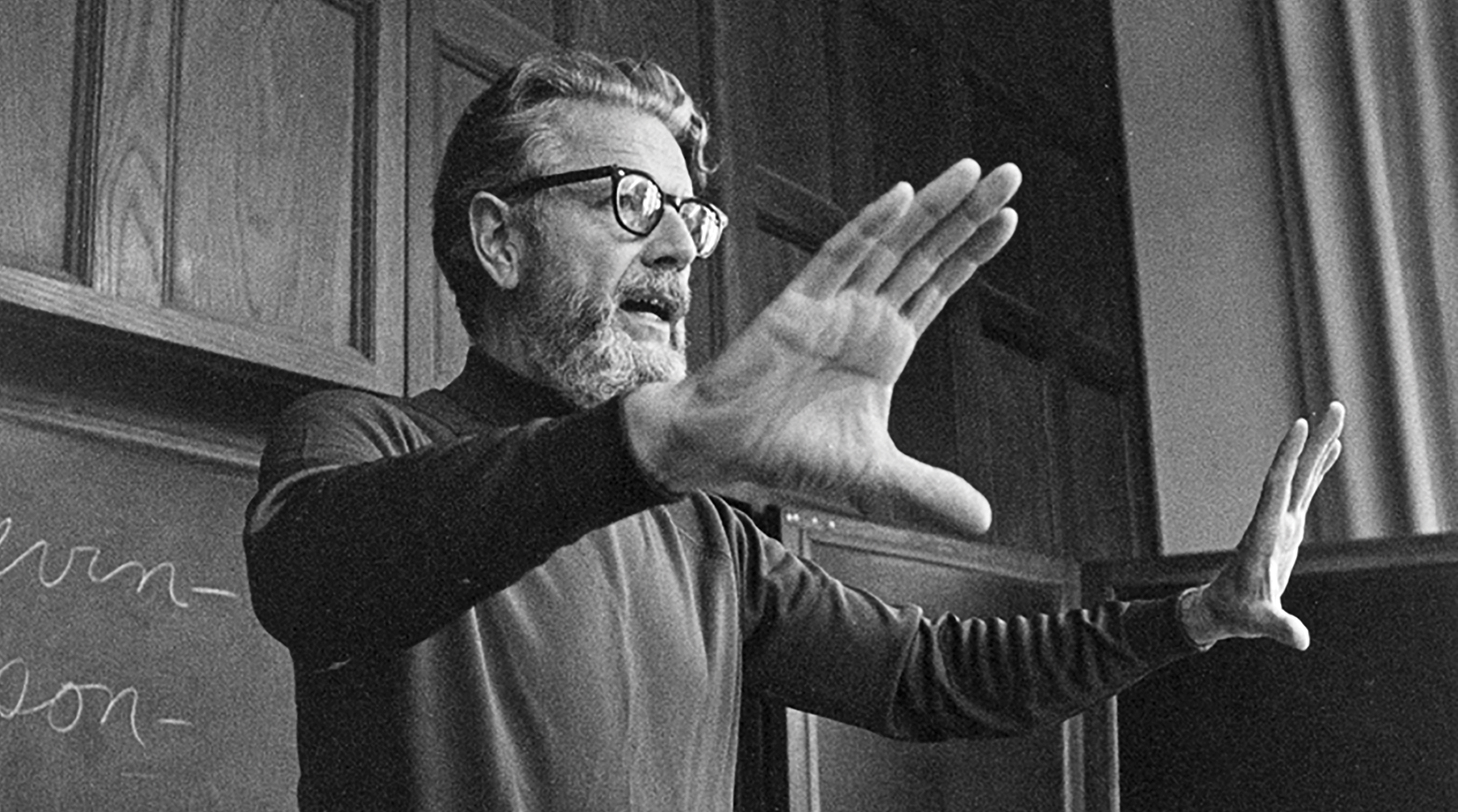
Wayne Booth, speaking
Image Credit: The Chicago Maroon &University of Chicago Library

If there’s any hope, it lies in our prose. In his classic address to the 1963 annual meeting of the Conference on College Composition and Communication, Wayne Booth proposed “the rhetorical stance” as a corrective to the default “pedant’s stance” of many scholars and the students who imitate them. This stance, he suggested, “consists of ignoring or underplaying the personal relationship of speaker and audience and depending entirely on statements about a subject — that is, the notion of a job to be done for a particular audience is left out.” It is precisely this relationship to the reader that we writing instructors try to get our students (and their teachers) to take seriously, to care about.

Indeed, I have found that those of my peers I disagree with most strongly, namely, the writing instructors who want to banish the “five-paragraph essay,” have precisely this relationship in mind. Their hearts are in the right place. I just think they are wrong to soil a perfectly good writing exercise with the charge of pedantry. After all, the mere act of writing five paragraphs, with a clear thesis statement in the introduction and a clean landing in the conclusion, does not preclude developing a relationship to the reader. You just have to find the specific difficulty you’re helping them to overcome, you have to find the pocket.

Next week, I want to take a close look at Booth’s talk, which is also an exemplary piece of writing in its own right. So you might want to read it and form your own opinions in advance. It’s interesting to note that he explicitly confines himself to issues that can be addressed in the span of twenty minutes (even back in 1963 this was the standard length of a conference presentation, it seems.) My quick count puts it at 24 paragraphs, some of which are quite short. So there’s that.

Reading, Talking, Seeing

Every theory is a program of perception.

Pierre Bourdieu

Last year I wrote a post about analytical writing that many people found useful. My main point was that our analyses should attribute meaning to what the people we study have said and done. This provided a neat way to distinguish, paragraph by paragraph, your key sentences from the rest of the prose of your analysis. Your data tells you what your subjects said in your interviews (or how they answered your survey questions) or what they did while you observed them. You use this material to support interpretations of their experiences, i.e., statements about what their practices mean to them. The interpretations are expressed in the key sentences and your data supports those interpretations through quotation, paraphrase, and description. In this post I will try something similar with theoretical writing. I will argue that our theories are ways of seeing that emerge from discourse, i.e., the reading and talking we do in our discipline. The key sentences will delineate perspectives, i.e., ways of seeing, that the rest of the paragraph elaborates on the basis of a shared literature and an ongoing conversation. Let’s see how well this works.

Learning a theory takes a great deal of reading. This begins while we are students but continues throughout our research careers, and whether you’re a first-year student or a retired scholar, you will find that reading affects the way you see the world. “A book is more than a verbal structure or series of verbal structures,” said Borges; “it is the dialogue it establishes with its reader and the changing and durable images it leaves in his memory.” Those “durable images” are a good proxy for your theory. Reading a book about organizations, or economics, or history, or literature, installs lasting pictures of companies, markets, epochs, and classics in our memory, and these shape how we see such things when we encounter them in our own lives and in our research. Reading a book about the Great Depression shapes how we see the 2007-8 Financial Crisis and the COVID-19 Recession. Reading a book about Shakespeare shapes our perception of Beckett. And it isn’t just books that do this, of course; our mental models are constantly tweaked and challenged by the papers we read in the journals. Every time we see a theory applied to some object we see both the theory and the object a little differently. That’s the point.

Writing instructors never tire of telling their students that research is a conversation. They mean this both figuratively and literally. As Borges notes, there is a virtual “dialogue” between the readers and the (sometimes dead) authors who they’re “talking” to. But the specifically “academic” situation that many of us are immersed in offers plenty of opportunities for entirely real conversations. Living scholars, who are each other’s readers, meet in seminars and at conferences to share their results and challenge the conclusions of their peers. This is something Heidegger pointed out in a lecture back in 1938: “The research man no longer needs a library at home. Moreover, he is constantly on the move. He negotiates at meetings and collects information at congresses.” How much more true that is today! Even our writing functions more like talking when we post it to social media. While the jury is still out on whether it is an on-the-whole positive or negative influence, these new media certainly participate in the gradual formation of knowledge in discourse. They are a special case of the gradual perfection of our thoughts while speaking.

What we are ultimately working on is our “worldview”. Learning a theory isn’t just a lot of reading, and a theory doesn’t just give us something to talk about; it amounts to acquiring a way of seeing the world. This is what Pierre Bourdieu meant when he said that a theory is “a program of perception”. A theory will emphasize some things and downplay others, it will focus on some things and outright ignore others. In fact, a very good theory will make you entirely unable to see certain things and unable not to see others. The whole purpose of theory is to establish a perspective from which the phenomena you’re interested in will appear salient, and the relationships between them will become obvious. Ideally, with a good theory in mind, what you’re looking for in your data will be visible at a glance. Of course, this only actually happens after you have analyzed you data. But if you have built a good model you should be able to easily present your result to a reader who is familiar with your theory. You simply look at things in the same way.

How can you implement these ideas when writing your theory section? First, make sure that your key sentence articulates a “way of seeing” or calls up, if you will, a “subroutine” in your “program of perception.” As an example, consider the perfectly theoretical notion that “sensemaking is a retrospective process.” That also happens to be a perfectly good key sentence for a paragraph; it tells us to see sensemaking as a backward looking process. While not all theoretical statements will use a so obviously visual metaphor, you may be surprised how often it does happen once you start looking for it. In any case, to elaborate on the retrospective nature of sensemaking will normally involve citing Karl Weick and those who have built on his seminal work. We decide what scholarship to invoke on the basis of the discussion we’ve had with our peers, in class, in seminars, at conferences, and over coffee (or worse poisons). “Sensemaking is a retrospective process. Weick (1995) originally suggested that … But it is sometimes argued … The most recent studies indicate …” Every paragraph in your theory section could well feel like that: a way of seeing elaborated with reference to the literature and the conversation you share with your peers.

See also: “How to Read”

Virtual Facework

Then stop. The writer now turns the microphone and camera back on and says a simple, “Thank you.” Let another minute or so pass in silence. Look at each other’s faces. Then say a polite, “Good bye,” and hang up. That’s it.

That probably sounds stranger out of context than it already did in context. Am I being serious? Yes, I am being totally and completely serious. And, after trying it a few times, you will understand what I mean perfectly. You may not enjoy the experience, and you may decide never to do it again, but you will understand why I suggested it. And a part of you will have learned an important lesson. However much the rest of you wants to repress it, that part of you will at some point reassert itself and demand to take another shot at it.

We sometimes talk about “finding our voice” in writing; here we’re putting on our face and giving our reader one. For 3 or 6 or 9 minutes you have listened to someone else make sense of your text and you have watched their face while they struggled. They were unable to look at yours to see how they were doing. They were utterly alone with your words and you witnessed what those words were doing to them. You could see what pleased and pained them, what puzzled them, and what was clear. You could empathize with your reader as they read your words. You got a great deal of information about how your writing works.

Now it is over. You have an urge to explain, to apologize, to excuse. And so does your reader, no doubt. They want to tell you it was “very interesting” or probably only hard to understand “out of context.” You want to tell them it’s okay, you didn’t take it personally. Their comments were very helpful. Etc. Your impulse (and theirs) is to “save face” (both yours and theirs), to engage in what Erving Goffman long ago called “facework”. You can’t help having the impulse, but with a little discipline you can do something more interesting with it.

By imposing a rule, you can experience something you might not otherwise notice. When the timer runs out and the feedback is formally over, both of you resolve not to say anything for a minute. You turn your camera back on, then the microphone. And you say a formal, but entirely sincere “Thank you.” For the next minute you just sit there, letting the reader look at the face of the writer of the words they just struggled with. Try not to communicate anything explicitly with your expression. Relax and think about what just happened. Be grateful (you should be) but don’t look for words to explain yourself. Don’t try to summarize what the reader has just “taught” you about your writing, not even silently. Just notice how you feel and let the reader observe that awareness for one minute.

Then say goodbye, formally and politely, and go on with your day, letting them go on with theirs. This experience, especially if you repeat it, will become part of your style. You don’t have to remember anything in particular. In fact, it’s fine if you forget it. Something will remain with you nonetheless. You will have demystified the relationship with the reader without trivializing it. You are learning how to find yourself “correctly attuned in the apportionment of the moment.”